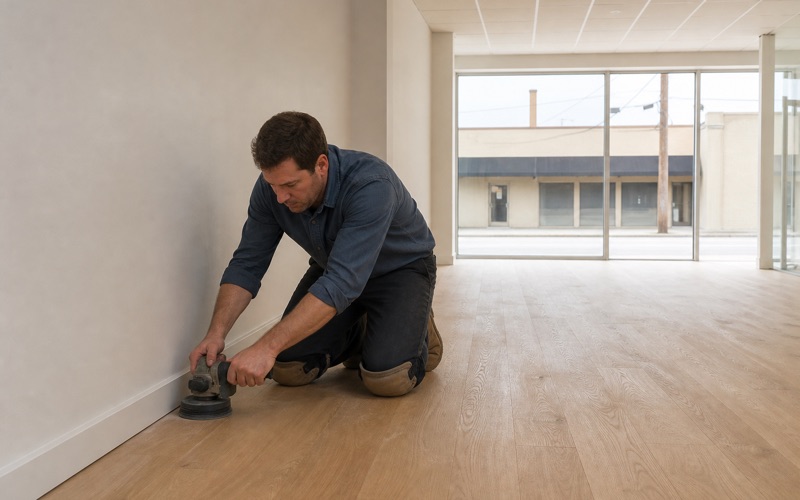
Bell Gardens Wood Flooring works on wood flooring in Walnut Park more often as a restorer than as an installer, and the reason is in the housing itself. Around seven houses in ten here predate 1950, which is the oldest stock anywhere in our service area by a considerable margin. Houses of that age were built with materials that are no longer available at any price. The framing is old-growth Douglas fir, the subfloor is frequently the same, and the finish floors laid over them were oak or fir strip of a grade that would be a premium product today.
What that means practically is that the most valuable wood in one of these houses is regularly the layer nobody has looked at. We lift a corner before quoting, because on this particular stock the difference between a replacement job and a restoration is often several thousand dollars in the customer’s favor.
What Is Actually Under the Floor
Old-Growth Fir as a Subfloor
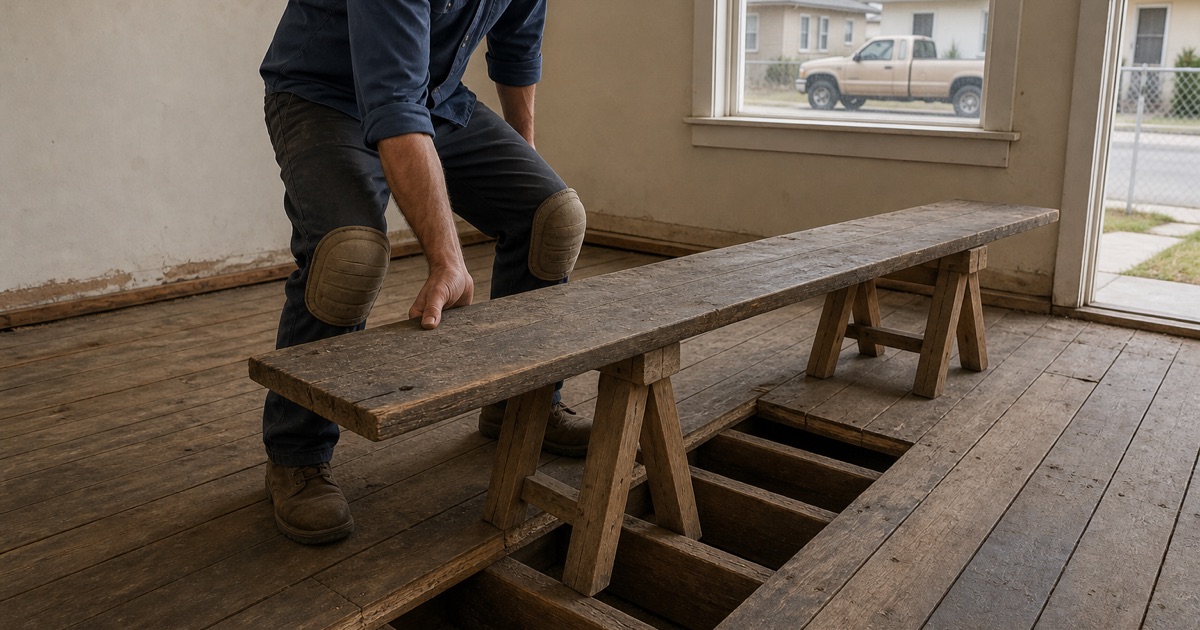
Board subfloor in houses of this era is commonly Douglas fir milled from timber that grew slowly over centuries, which produces a tight, dense grain quite unlike the fast-grown fir sold today. It was used as a structural layer, not a finish, so it was never treated as valuable. That material is dimensionally excellent and it has already done seventy or eighty years of moving without failing. Where it is sound, it is a better substrate than anything we could install over it, and it deserves to be assessed rather than covered.
Occasionally it deserves more than that. On houses where the finish floor above has been destroyed, sanding and finishing the original subfloor itself produces a genuinely beautiful floor with a width and character that no current product matches.
Deciding Whether to Expose It
That is not a decision to make casually, and we are careful about how we present it. A subfloor was laid to be covered, so it carries saw marks, fastener holes, gaps between boards and areas of staining that a finish floor never would. Some of that reads as character and some of it reads as damage, and which is which depends on the room and on the person living in it. We show you the actual boards after a test clean rather than describing what they might look like.
There is also a structural consideration that gets missed. Sanding a subfloor removes thickness from a layer that is doing a structural job, so it is only sensible where the boards are thick enough and well enough supported to lose a little.
Sanding Softwood Without Ruining It
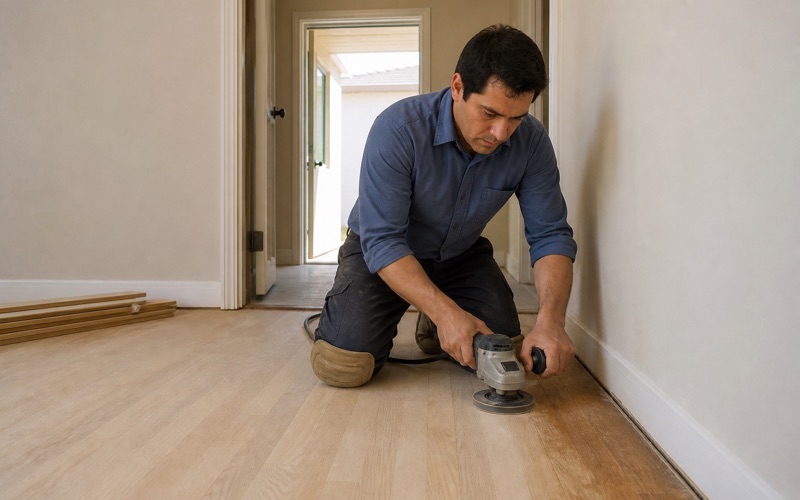
Fir sands far faster than oak, and the machines that suit a hardwood floor will take too much off a softwood one in a single pass. It is the most common way an original fir floor is spoiled by somebody with the right equipment and the wrong instincts. We work through the grit sequence with a lighter cut and check progress far more often than we would on oak. The aim is to remove the damage and nothing beyond it, because every fraction taken off is thickness the floor cannot get back.
Softwood also shows machine marks more readily. Chatter, dishing at the edges and the ring where the edger meets the field are all more visible here, so the buffing stage that blends them is not optional on this material. Looking for wood flooring closer to Pico Rivera? See Pico Rivera Wood Flooring.
What the Age of the Stock Means
Lead-Safe Practice Is Not Optional
With this proportion of housing predating 1978, effectively every sanding job here falls under the federal Renovation, Repair and Painting rule. Sanding is precisely the disturbance that rule governs, and older paint layers around a floor perimeter are exactly its concern. Containment, sealed openings, controlled cleanup and proper waste handling are simply how the work runs rather than an upgrade offered later. We would work this way on these houses regardless of the requirement.
It also produces a materially better finish. Most of what spoils a coat is airborne dust that was allowed to settle onto it, so a properly contained job looks better as well as being safer to live through.
Structure That Has Been Moving for Ninety Years
A house this old has settled, and settlement shows up in a floor before it shows anywhere else. Slopes across a room, a hump over a bearing point and gaps that reopen every year are all normal reports from an old structure. Some of that is stable and finished moving decades ago, and some of it is active. Telling them apart matters, because a floor laid across active movement will repeat whatever the structure is doing regardless of how well it was installed.
Where we think something is active we say so and say it is not ours to fix. Foundation, bracing and framing repair belong with a general contractor or a structural engineer, and we would rather wait for that work than lay a floor over an open question.
Crawl Spaces That Were Never Improved
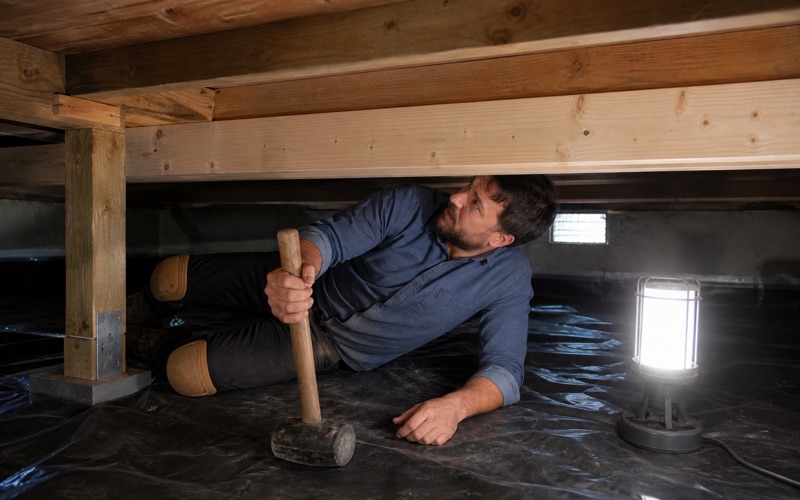
Under a house of this age the crawl space is frequently exactly as it was built, with bare soil, original venting and no ground cover at all. That soil releases moisture into the joists and the underside of the floor continuously, all year round. A properly laid 6-mil polyethylene ground cover with genuinely clear vents corrects a surprising share of cupping complaints on its own. It is one of the cheapest interventions available in this trade and among the most frequently skipped.
We look before quoting any floor work at all. Sanding a floor flat while the moisture source underneath is still active buys one season and permanently spends thickness that a floor of this age can rarely afford.
Working in a Dense, Long-Settled Neighborhood
Access on Narrow Lots
Lots here are close-set and driveways are narrow, so getting pallets of material and a set of machines to a house takes more planning than a wider street would need. We walk the route before quoting rather than discovering it on delivery day. Material also has to sit inside the house to acclimate, with readings logged on arrival and again before the first board goes down. In a small house that is a genuine imposition, so we agree where it goes in advance with whoever lives there.
None of this is difficult and all of it is worth ten minutes at the quote. A crew improvising around somebody’s furniture on the first morning is how a job starts badly and stays that way for a fortnight.
Noise, Dust and the House Next Door
Sanding is loud and the houses here sit close together. Construction work in the area is restricted in the evenings, and we schedule the noisy stages to finish comfortably inside those limits rather than pressing against them. Containment matters more for the same reason. Dust that escapes a working room in a small house reaches a kitchen somebody has to cook in, and extraction at the machine is what stops it entering the room at all.
We clear the access route at the end of each day rather than at the end of the job. It costs a few minutes and it is the difference between a tolerable fortnight and a genuinely disruptive one.
Occupied Houses and Phasing
Most of this work happens with the household staying put, so the sequence gets planned before anything is ordered. Which rooms go first, where furniture goes and which nights a coated floor closes a route are all agreed at the quote. Waterborne finishes cure faster and carry far less odor than oil-modified systems, which usually matters more in an occupied house than any difference in appearance does. We lay that out in dates rather than in reassurance.
Where the layout makes a workable sequence impossible, we say so early. On a very small plan there is occasionally no order that keeps every room reachable, and that is worth knowing at the quote rather than at nine in the evening.
Restoring Rather Than Replacing
The Cost Comparison People Do Not Expect
A restoration on this stock is very often cheaper than a replacement as well as better, which surprises people who came to us expecting to price a new floor. There is no material to buy, no subfloor preparation and no disposal beyond the sanding waste. Walnut Park is a census-designated place adjacent to Florence-Graham, Huntington Park and South Gate, with a population of 15,214 at the 2020 census. It is a small, dense, long-settled community, and the housing has largely stayed in use rather than being redeveloped.
That continuity is why so much original material survives here. In areas that turned over faster, these floors were pulled out decades ago and are simply not available to restore.
When Replacement Is Genuinely Right
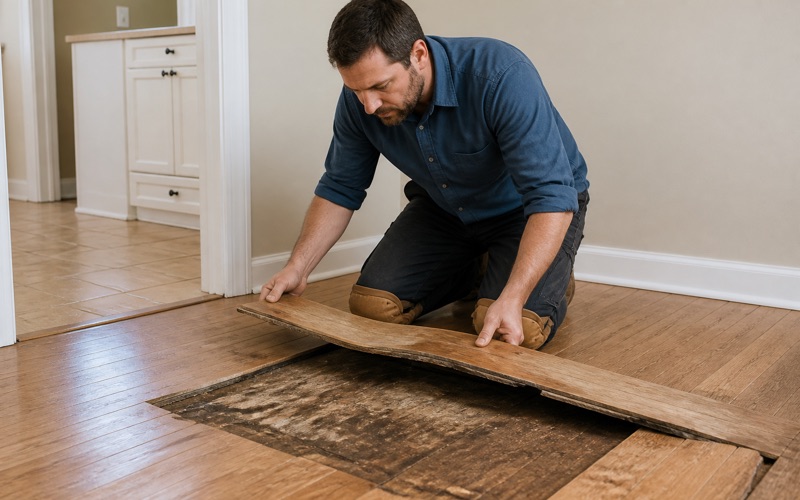
We are not sentimental about it. A floor sanded down to the tongue has nothing left to remove, and no amount of skill puts thickness back into a board that has already given up four refinishes. Widespread water damage, delamination and boards that have split along the grain across a whole room are all replacement conditions rather than restoration ones. So is a subfloor that has failed underneath an otherwise reasonable floor.
Where that is the case we say so directly and price a replacement properly. The point is not that old floors are always worth saving, it is that the question deserves asking before the boards go in a skip.
Matching Board of This Period
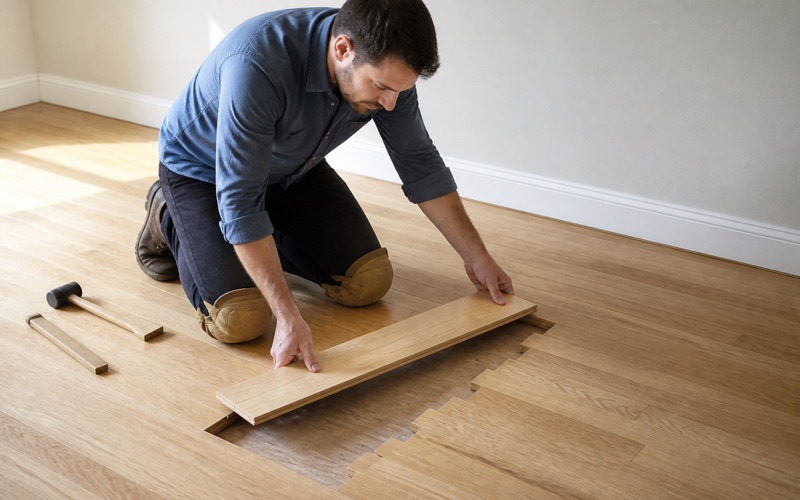
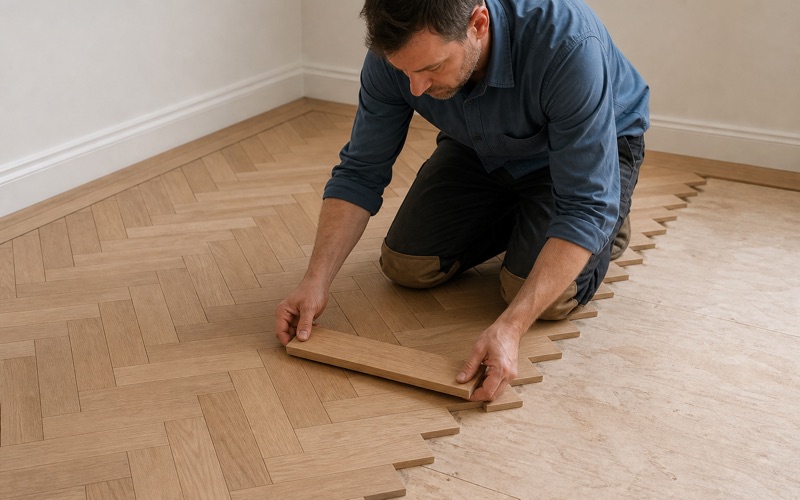
Where individual boards need replacing within a restored floor, the profile is far harder to match than the species, because tongue and groove milling has changed and thickness was much less standardized in this era. Salvage is usually the answer and it is worth the search. Reclaimed board of the right period, species and thickness can be worked to fit, and on a floor worth restoring the extra sourcing time is a small part of the total.
We tell you at the quote whether a genuine match is achievable rather than discovering it with the floor already open. That is the point at which a modest repair turns into an argument about a whole room.
- Licensed & Insured
- 20+ Years Experience
- Free Written Quotes