
Bell Gardens Wood Flooring installs solid hardwood floors in Bell Gardens, CA and nearby cities including Walnut Park, Huntington Park, South Gate, East Los Angeles and Maywood. Solid wood is the longest-lived floor available, and whether you can have one is decided by what your house sits on rather than by budget. Roughly a third of the housing stock in this city predates 1950, and a good deal of it is raised construction over a crawl space with a board or plywood subfloor. On those houses solid nail-down is not only possible, it is usually the right answer: it can be sanded and refinished several times across a very long life, and it is frequently what is already under the carpet.
On a slab, solid wood is generally the wrong product and we will say so rather than take the work. That is the first thing we establish, before species, grade or finish is discussed at all.
Where Solid Wood Belongs
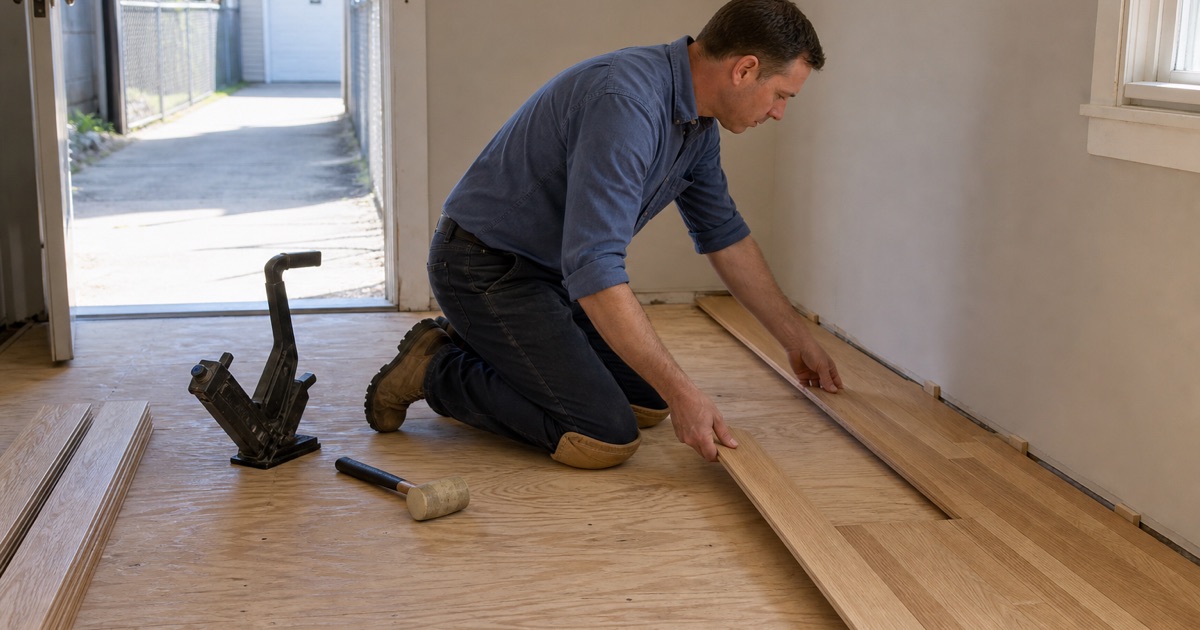
Raised Floors and Crawl Spaces
A raised floor gives you a wood subfloor to fasten into, which is what solid hardwood needs. It also gives access underneath for inspection and for correcting moisture, which matters because a crawl space is the most common source of trouble in a solid floor. We check the crawl before quoting rather than after.
Why Not Over a Slab
Concrete offers nothing to nail into and is a continuous source of moisture, while solid wood moves considerably with moisture and needs mechanical fixing. Systems exist that build a fastenable surface over a slab, but they raise the finished floor height significantly and cost more than the floor. They suit specific situations and we will tell you if yours is one.
Checking the Subfloor First
Board subfloor that has cupped, plywood that has delaminated or a deck that moves underfoot all get corrected before the finish floor goes on. A solid floor fastened to a moving subfloor moves with it and develops squeaks and joint separation regardless of how well the boards themselves were laid.
Choosing the Floor
Species and Hardness
The Janka scale measures resistance to denting: white oak sits around 1360 and hickory around 1820, which is meaningfully harder. Hardness is not the only consideration, since grain pattern and finish conceal wear at least as effectively as density does. We match species to how the room is actually used rather than defaulting to the hardest option.
Grade and Appearance
Mill grade describes appearance rather than strength, running from clear and uniform through grades carrying knots, mineral streak and color variation. Traditional mill grading rules such as those long used by NOFMA are what make grade names comparable between suppliers. We show you a full box rather than a single sample, because one board does not represent a grade.
Board Width and Thickness
Narrow strip is the most stable and the most traditional, and it is what most older floors here are. Wider boards move more and need more from the substrate. Standard thickness matters because it determines how many refinishes the floor has in it, which is the whole argument for solid wood in the first place.
Before the Floor Goes Down
Checking the Crawl Space
We look at what is under a raised floor before quoting: whether there is a ground cover, whether the vents are clear, whether any joist has rot at a bearing point. Correcting moisture underneath is cheaper than any floor and it is what determines whether a solid floor lasts decades or years.
Removing What Is There Now
Carpet and tack strip always come up, and on many houses here what is underneath is original oak or fir that may be worth refinishing instead of replacing. We look before assuming, because on older stock the existing boards are frequently better material than what would replace them.
Installation
Acclimation and Moisture Content
Material is delivered and acclimated in the rooms it will live in, with moisture readings logged on arrival and again before the first board is fastened. Wood laid at the wrong moisture content gaps or cups within its first year, and no amount of care during installation compensates for skipping this.
Fastening
Solid floors are blind-nailed through the tongue with cleats or staples at a spacing schedule set by the board’s width and thickness. Under-fastening a wide board is a common cause of squeaks appearing in a floor’s second year. We follow the schedule the material calls for rather than a habit carried from a previous job.
Expansion Gaps and Trim
Every solid floor needs a perimeter expansion gap so the field can move as a unit, concealed under baseboard or shoe molding. Filling that gap or fitting cabinetry hard against the floor is one of the most reliable ways to buckle an otherwise sound installation. Transitions and thresholds are detailed so the floor can move where it needs to.
Site Finishing
A site-finished solid floor is sanded flat after laying and coated in place, giving a continuous surface with no micro-bevels to collect grit and exact control over color. It costs days on site against prefinished board. We lay both options out against your schedule rather than steering you to whichever suits ours.
- Licensed & Insured
- 20+ Years Experience
- Free Written Quotes