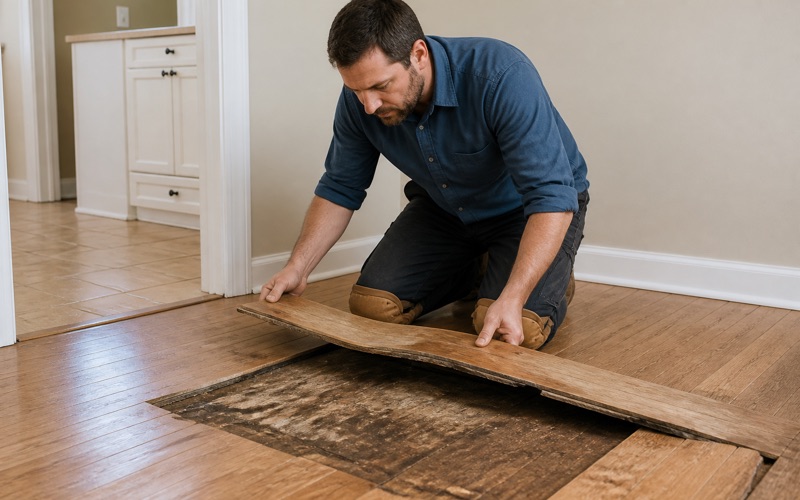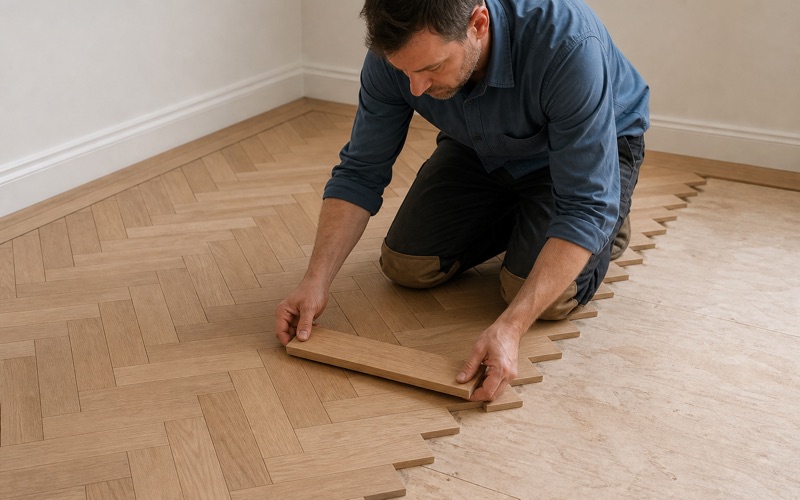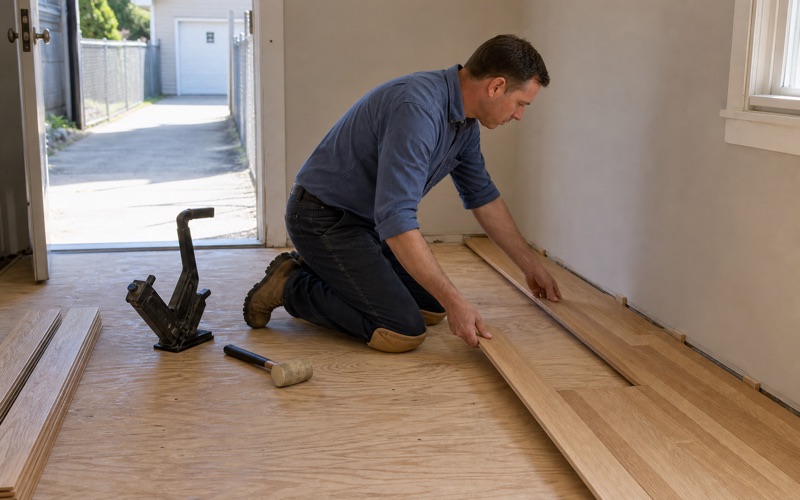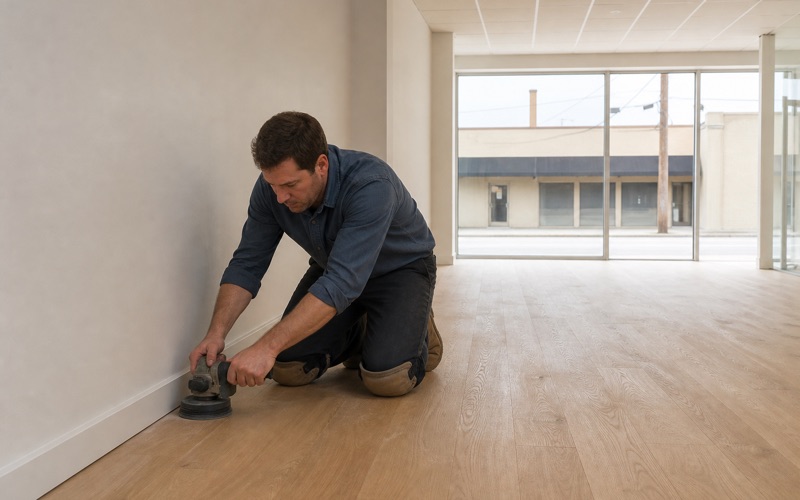
Bell Gardens Wood Flooring provides wood flooring in Signal Hill, and this is the one city in our service area where we will not quote a floor without putting a level across the rooms first. The city sits on and around an oil field that has been in production since the early 1920s, and ground movement associated with that history is documented rather than speculative. A wood floor is a large, flat, continuous plane, which makes it the most sensitive indicator of movement in a building. Walls hide small changes behind paint and trim; a floor does not, and a fall of half an inch across a room that nobody had consciously noticed shows up the moment a hard floor goes down.
None of that makes a wood floor a bad idea here. It means the survey comes first, the substrate work is priced honestly, and the specification is chosen for the conditions rather than from a catalog. Done in that order these floors last perfectly well.
Surveying Before Anything Else
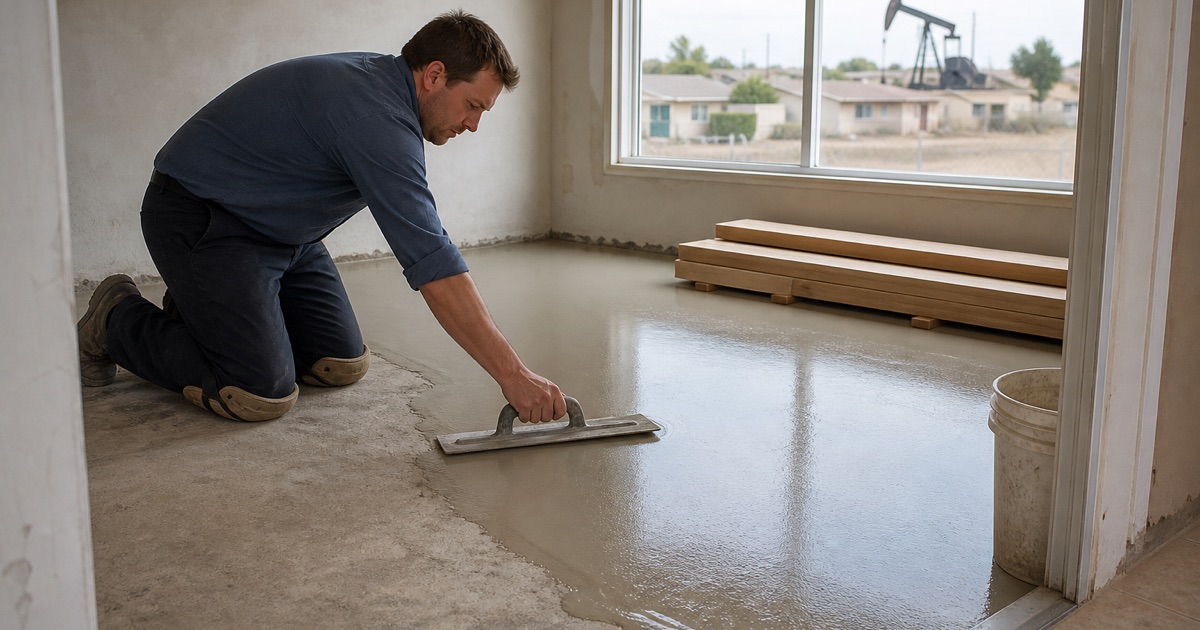
Putting a Level Across the Rooms
We run a level across every room before quoting rather than after, and on this ground it regularly finds a fall that the household had stopped noticing years ago. People adapt to a sloping floor remarkably quickly. That number decides several things at once: whether a floating floor is viable at all, how much self-leveling compound would be needed, and whether a transition belongs at a particular doorway. All of them are far cheaper to settle before material is ordered.
Signal Hill is a 2.2 square mile city incorporated in 1924, roughly three years after oil was discovered there, and it sits partially high on its eponymous hill as an enclave completely surrounded by Long Beach. Its topography and its history are the two facts that shape this work.
Telling Settled From Active
Some movement finished decades ago and some is ongoing, and the two need completely different responses. A floor laid across active movement will repeat whatever the structure is doing regardless of how well it was installed. The indicators we look for are cracks that have been filled and reopened, doors that have been repeatedly adjusted, and previous floor repairs in the same location. A problem that has been fixed twice is usually still a problem.
Where we think something is active we say so plainly and say it is not ours to resolve. Foundation assessment belongs with a structural engineer, and we would rather wait for that answer than lay a floor over an open question.
What We Will Not Do
We will not lay a floor over a substrate we believe is still moving without saying so in writing first. It is the customer’s decision to proceed and it should be an informed one rather than a surprise eighteen months later. We will also decline to sand a floor that is cupped from an unresolved source. Sanding wet or moving wood flat produces a crowned floor as it settles, on less remaining thickness than before.
Those refusals cost us work occasionally and they have never been the wrong call. A floor that fails is remembered considerably longer than a job we turned down. We put the reasoning in writing rather than delivering it verbally at the door. A customer who wants a second opinion should be able to hand somebody our findings rather than reconstruct them from memory.
Looking for wood flooring closer to San Marino? See Wood Flooring Services in San Marino.
Choosing a Floor for This Ground
Floating Floors and Their Limits
A floating floor moves as one field rather than being pinned to a substrate, which sounds ideal on ground that moves and is only half the story. It is also the least tolerant option of a substrate that is out of flat. Where movement is historic and the substrate can be brought to tolerance, floating works well and accommodates future minor change better than a bonded floor. Where the fall is significant, it is the wrong choice.
We match the method to what the survey actually found rather than to a general principle about movement. The measurement decides, not the theory.
Glue-Down and Solid Wood
Glue-down bonds the board to the slab, which gives a solid feel underfoot and ties the floor to whatever the slab does next. On stable ground that is an advantage and on moving ground it transfers the movement directly into the finish. On a raised floor, solid nail-down remains the longest-lived option and it is available where the framing is sound. A properly built raised structure also has some capacity to be re-leveled from below, which a slab does not.
We will explain that trade rather than steering to one answer. There is a legitimate case for each on this ground and it depends entirely on what the survey found. Where a raised floor is being re-leveled from below, that is structural work with its own permit position rather than finish work. We quote it separately and say plainly when it belongs with a general contractor.
Transitions Where Levels Differ
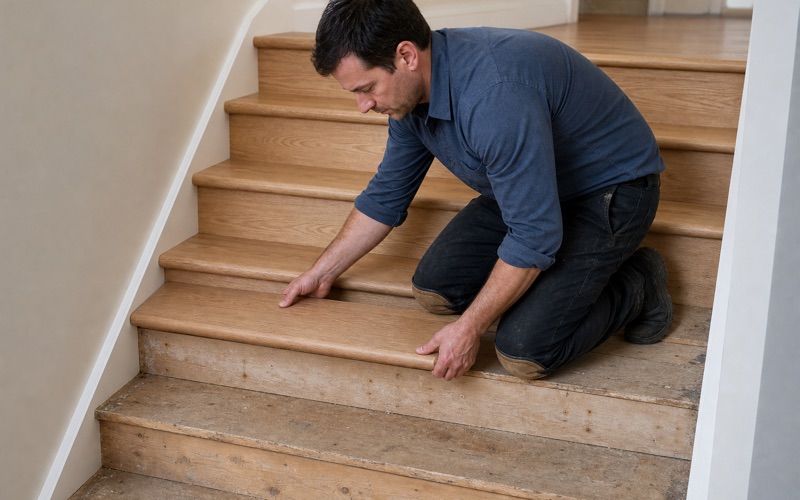
Where a floor genuinely cannot be brought to a single level, a properly detailed threshold at a doorway is a far better outcome than a floor with a visible dip running through it. Made deliberately it reads as intentional joinery. Split-level plans are common here, and where a change is more than a step there is a staircase. Stairs are joinery rather than flooring and we are clear at quote stage about which parts of that work are finish work.
Replacing treads over sound existing structure is finish work. Altering rise, run, stringers or a handrail is construction with a different permit position entirely.
Substrate Work
Bringing a Slab to Tolerance
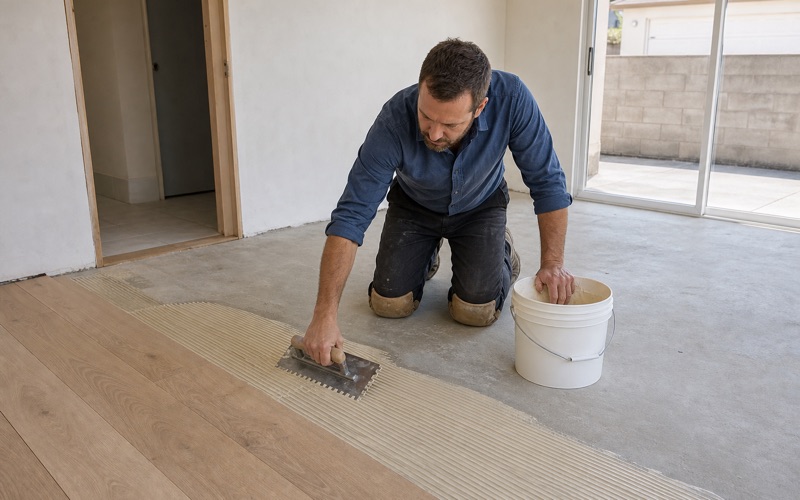
Where a slab is out of flat the remedies are grinding high spots, patching local defects, or a self-leveling compound across the area. Which applies depends on whether the problem is high, low, or general fall. There are practical limits to compound. It has a maximum useful depth, it adds weight, and it raises floor height at every doorway, all of which matter on a floor that is significantly out of level.
We price this as its own line rather than folding it into a rate per square foot. On this ground it is frequently the largest item on the quote and it should be visible and questionable.
Moisture Testing
Concrete releases moisture for far longer than most people expect, and slabs of the older vintage here frequently have no vapor retarder beneath them at all. Ground moisture arrives continuously and will keep doing so. Probes go in to the ASTM F2170 method and are left to equilibrate before anybody reads them, and on this ground we take readings at more than one point in a room. A slab that has moved is rarely uniform, and a single probe in the middle of a floor can miss a wet corner entirely.
The reading decides the adhesive and whether a moisture mitigation system is needed. Those are responses to a number rather than insurance applied to every job as a matter of course.
Raised Floors and What Is Underneath
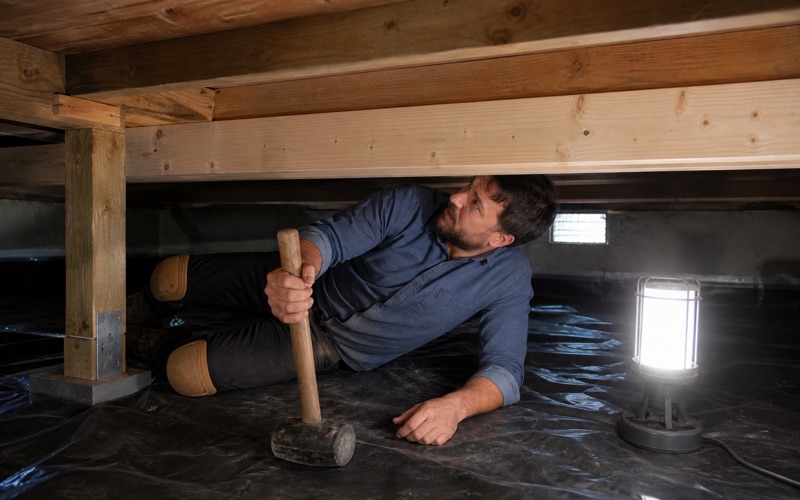
Where a house sits on raised construction, the crawl space is where a great many problems are actually resolved. Bare soil releases moisture into the joists and the underside of the boards continuously through the year.
A polyethylene ground cover with genuinely clear vents corrects a surprising share of cupping complaints for very little money. On sloping ground the low end of a crawl is usually the damp end and repays specific attention. We look before quoting any floor work, because sanding a floor while the source underneath is still active buys a single season and permanently spends thickness.
Living With the Floor
Repairs Over Time
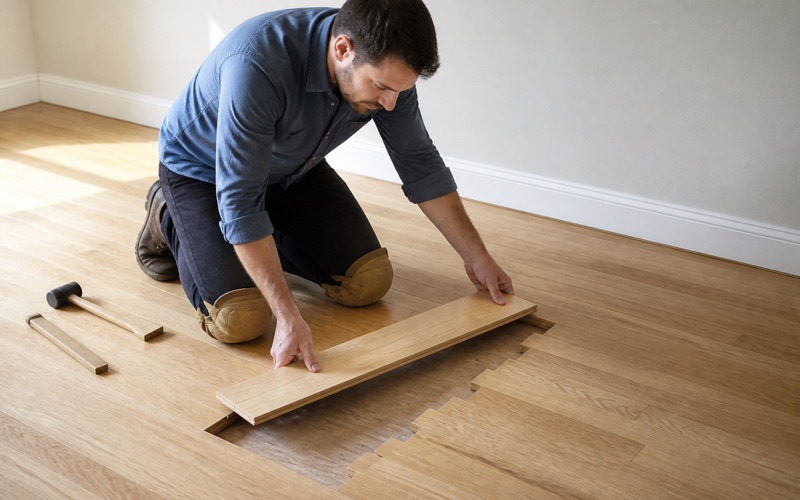
On ground like this, a floor that can be repaired locally is worth considerably more than one that cannot. Individual boards lift and weave in so a repair disappears into the surrounding field. Keeping a small quantity of the original material at the end of the job makes that straightforward years later, and we set some aside as a matter of course.
We record product, grade, width, thickness and finish specification for every floor we lay. A repair matching rather than approximately matching depends entirely on that record existing.
Watching for Change
We tell customers what to watch for: a gap that opens and does not close seasonally, a door that starts binding, or a new soft spot underfoot. Those are worth reporting early rather than after a year. Caught early, most of these are small adjustments. Left alone they become the reason a floor has to be lifted, which is a completely different cost.
None of that is alarmist. It is simply the sensible level of attention for a building on ground with a documented history, and most houses here never need any of it.
Cleaning and Ordinary Care
Wood floors are damaged far more often by cleaning than by traffic. Standing water, steam mops and abrasive products all take life off a finish, and steam drives moisture straight into the joints.
A dry pick-up followed by a barely damp pass with a cleaner made for the finish actually on the floor is the entire routine. We tell you which finish you have. Felt pads under furniture and a mat at the entry do more for a floor than any product on a shelf, and cost almost nothing.
- Licensed & Insured
- 20+ Years Experience
- Free Written Quotes