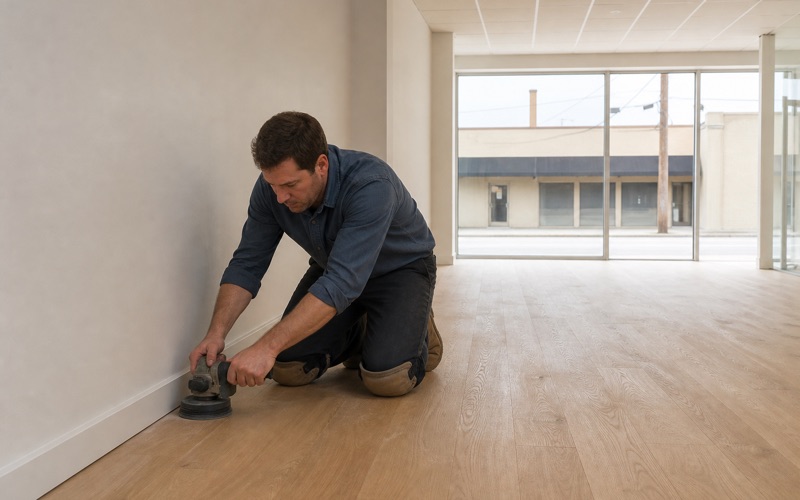
Bell Gardens Wood Flooring provides wood flooring in Santa Fe Springs for a city where most of the land is working rather than residential. The great majority of what we are asked to floor here sits inside a commercial or industrial building: offices, showrooms, reception areas and the front-of-house parts of premises whose back-of-house is something else entirely. Commercial wood flooring is a different job from residential work using the same materials, and the differences are traffic, scheduling and code. A retail or office floor takes in a week what a domestic floor takes in a year, which changes the finish system, the maintenance interval and sometimes the species.
The scheduling difference matters just as much. Very few businesses here can close for a week, so the work is phased, sequenced around operating hours and planned so each stage leaves the space usable. A large part of what a commercial client is buying is that planning rather than the flooring itself.
Specifying for Commercial Traffic
Finish Systems That Survive Use
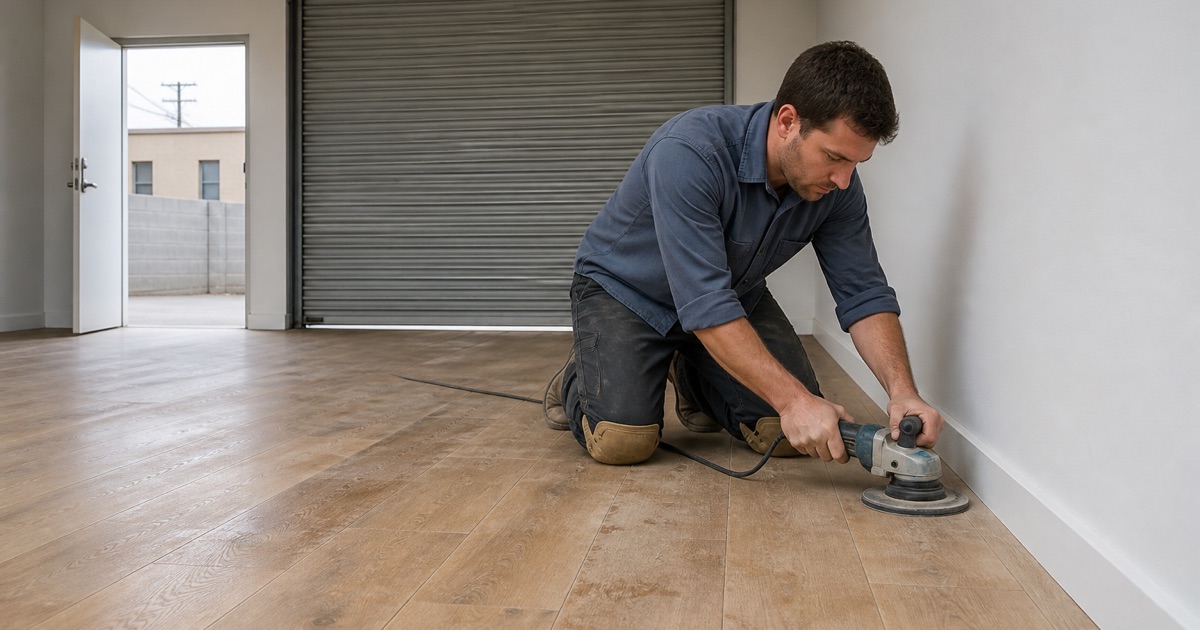
Commercial finishes are harder and more abrasion resistant than domestic ones and are generally applied in more coats. Specifying a residential system for a commercial floor is the most common reason a wood floor looks tired within eighteen months of opening. Moisture-cure urethane and commercial-grade waterborne systems both have a place, and the choice turns on cure time, odor during application and how quickly the space has to be back in service. All of it is specified within the 275 gram per liter limit for wood coatings that applies in this air basin.
That limit reaches the contractor who stores and applies the product rather than only the manufacturer who sells it, so it constrains the catalog rather than the quality. Plenty of professional systems sit comfortably inside it.
Sheen, Traffic Lanes and Wear
Commercial traffic concentrates in predictable paths, so wear appears in lanes rather than evenly across a floor. Finish choice, sheen and board direction all affect how visible that becomes over the first few years. A lower sheen conceals traffic marking substantially better than a gloss finish, which is the opposite of what most people expect when choosing from a sample under showroom lighting. It is the single easiest decision to get wrong at specification.
Board direction matters too. Running boards along the main traffic path rather than across it makes lane wear considerably less obvious, and it costs nothing to decide correctly at the outset.
Species and Hardness for Working Floors
The Janka scale measures resistance to denting, with white oak around 1360 and hickory around 1820, and on a commercial floor that difference is worth considering rather than dismissing. Harder species genuinely last longer under concentrated traffic. Hardness is not the whole story, though, and grain and finish conceal wear at least as effectively as density does. A busy grain in a mid-range species frequently outperforms a plain one that is technically harder.
We match species to what the space actually does rather than defaulting to the hardest option available. A showroom and a service counter are different problems even inside one building. Looking for wood flooring closer to Monterey Park? See Wood Flooring Services in Monterey Park.
Code, Access and Permits
The Accessibility Qualifier
The permit exemption that covers floor covering as finish work carries a qualifier which residential work almost never meets and commercial work frequently does: it applies where disabled access requirements do not apply. Thresholds and transitions are exactly where those requirements bite, since a change in floor level or an abrupt edge at a doorway is precisely what accessibility rules address. On a commercial job it is a real consideration rather than a technicality.
We raise it at quote stage rather than leaving it to be discovered at an inspection. It is rarely an obstacle, and it is far cheaper to design a compliant transition at the start than to rework one after the floor is down and the business is trading on it.
Separate Trade Permits
An exemption for finish work does not exempt anything else that happens to be part of the same project. Where a floor job involves electrical, plumbing or mechanical work, those carry their own permit requirements independently. The exemption also does not authorize work that violates any other provision. It is a narrow allowance about floor covering rather than a general permission, and it is regularly overstated by people quoting on commercial premises.
We are straight about which parts of a project sit inside it and which do not. On a commercial fit-out that clarity is worth having in writing before anybody starts.
Structural Work Under a Commercial Floor
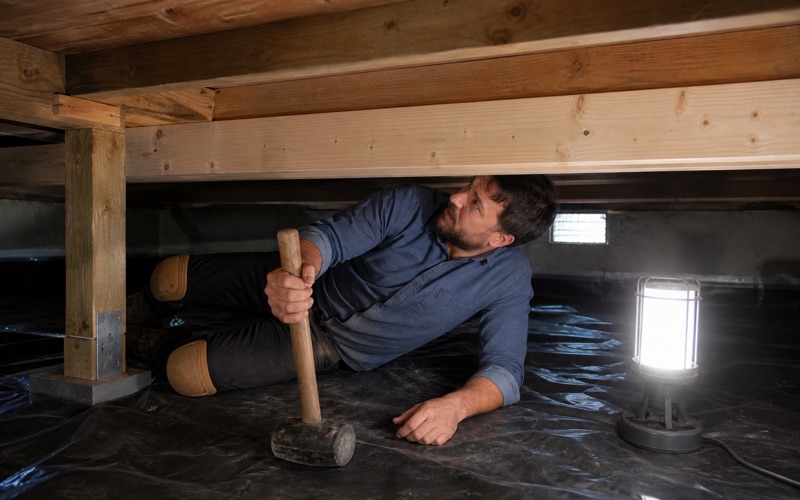
Where a commercial floor sits over a timber structure and that structure needs repair, the work is altering the building rather than covering it, which is permit work in its own right. That distinction holds regardless of the finish work exemption. Most commercial floors here are on slab, so this arises less often than it does on residential jobs. Where it does arise it is usually in an older building that has been converted, and those are worth surveying properly before anything is promised on a schedule.
We quote structural work as its own line and say plainly when it belongs with a general contractor rather than with us. Working beyond a flooring classification is not something we do to keep a job.
Maintaining a Commercial Floor
Recoating on a Traffic Interval
A commercial floor stays alive by being recoated before the finish wears through to the wood, and the interval is set by traffic rather than by the calendar. A busy entrance may want attention twice as often as the space behind it. A screen and recoat abrades the existing finish and adds a fresh coat without touching the wood at all, at a fraction of the cost and disruption of sanding. It is usually a single overnight operation on a defined area.
Once traffic has worn through to bare wood the only route back is a full sand, which means closing a section for days rather than hours. Staying ahead of that is the entire economics of a commercial wood floor.
Repairs Without Closing
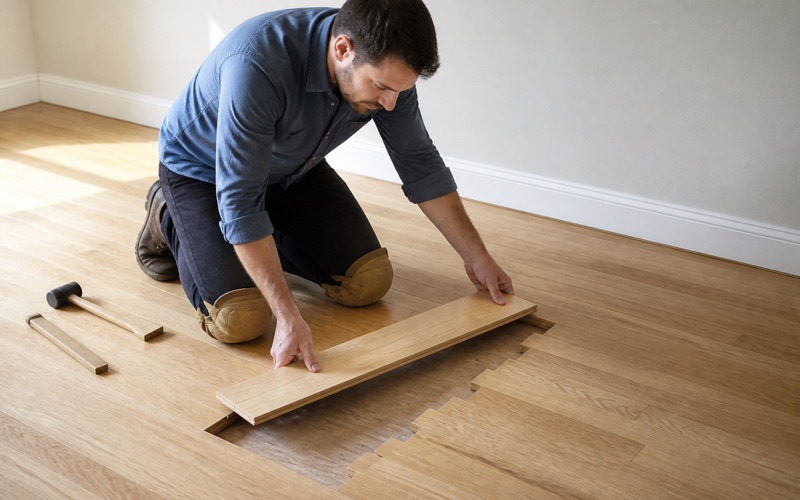
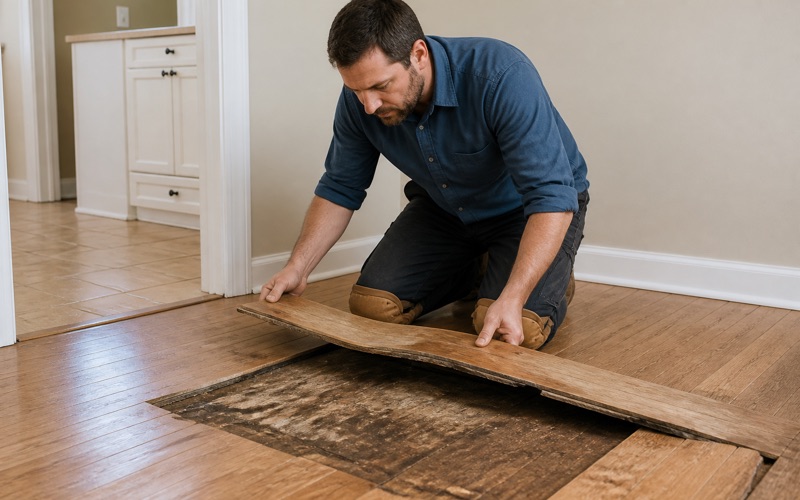
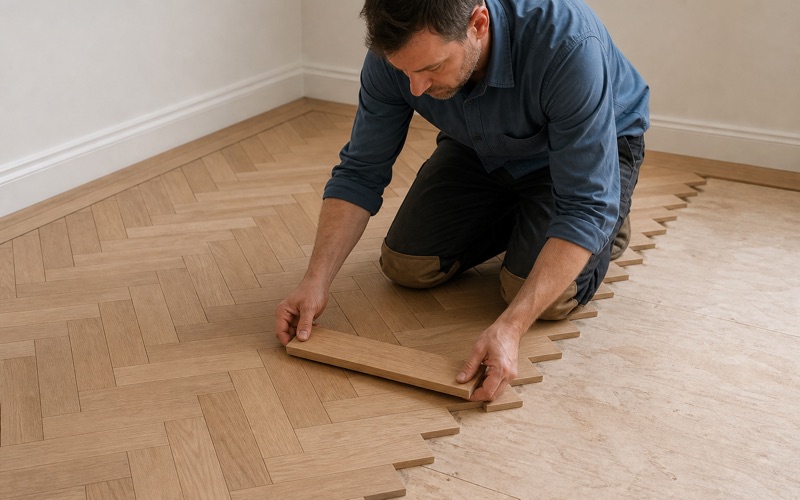
Localized damage is repaired by lifting the affected boards and weaving replacements into the surrounding field, which can usually be done in sections during quiet hours. It avoids closing the space and keeps the rest of the original floor. Where the existing finish has aged, a spot repair will show against it to some degree, and we are honest about how much rather than promising invisibility. Sometimes the right answer is repairing now and recoating the whole area at the next scheduled interval.
Keeping a small quantity of the original material on site makes all of this straightforward years later. We set some aside at handover and tell whoever manages the building where it has been put.
Records Across Phases
Wood varies between production runs, so a floor laid in phases over several years depends on a record if the later phases are to match. We document product, grade, width, thickness and finish specification for everything we install.
That record is worth more on a commercial building than a residential one, because the people managing the building change and institutional memory does not survive them. A specification on file does. It also makes a repair quotable without a site visit in many cases, which on a working building is a genuine convenience rather than a small one.
Working Around a Business
Phasing and Sections
Most commercial jobs here are done in sections so the space stays partly in use throughout, which takes planning rather than heroics. Which areas come out of service and when gets agreed before any material is ordered. Santa Fe Springs is one of the Gateway Cities of southeast Los Angeles County, with a population of 19,219 at the 2020 census, up from 16,223 a decade earlier. It is a small city by residents and a large one by working floor area, which is why so much of the flooring work here is commercial.
The practical consequence is that most of our clients here are scheduling around staff, deliveries and customers rather than around a family. That is a different planning problem and it wants discussing early.
Out-of-Hours Work and What Is Allowed
Overnight working is often the obvious answer and it cannot simply be assumed. Construction work is restricted in the evenings near residential zones, and parts of this city sit closer to housing than a map suggests. We check what is genuinely permitted before promising a schedule built around night work, rather than committing and then discovering the constraint. That check takes a phone call and it prevents a schedule collapsing in its first week.
Where genuine overnight work is not available, phasing across sections usually achieves the same result over a slightly longer period. It is almost always workable once it is planned rather than assumed.
Reopening: Cure Against Dry
The binding constraint on putting a commercial floor back into service is cure rather than dry, and the two are separated by days rather than hours on most systems. A floor that takes foot traffic is not necessarily ready for fixtures, racking or cleaning. We give the date the floor takes foot traffic and the later date it takes everything else, in writing. Putting a retail floor back into full service too early is the most reliable way to damage a new finish in its first week.
Rolling loads are the particular hazard, since a pallet truck or a heavy fixture on castors concentrates far more pressure than footfall does. We flag that specifically rather than assuming it is understood.
- Licensed & Insured
- 20+ Years Experience
- Free Written Quotes