Bell Gardens Wood Flooring provides wood flooring in Pico Rivera for a city where roughly seven households in ten own the house they live in. That single figure changes what a sensible recommendation looks like, and it is the highest ownership rate anywhere in our service area apart from a couple of much smaller communities.
An owner-occupier and a landlord are asking genuinely different questions. A landlord needs a floor that survives tenants and goes back into service on a date. An owner is going to live on this floor for a decade or two and will pay for it once, so the arithmetic runs over a much longer horizon.
That means the cheapest floor is frequently the wrong recommendation here. We would rather talk about wear layer thickness, refinish counts and recoat intervals than about the lowest first cost, because those are the numbers that decide what the floor costs across the whole time somebody owns it.
Buying a Floor for the Long Term
Wear Layer Is the Number That Matters
On an engineered board the wear layer is the only part that can ever be sanded, and it ranges from a veneer that can never be refinished to several millimeters that behaves much like solid wood. It is the difference between a floor with a second life and a floor without one. It is also the specification most often left vague in a retail conversation, where boards get described as thick rather than measured. We state it in millimeters on the quote so that two products can actually be compared against each other.
Over the twenty years an owner might keep a floor, that figure decides whether a tired surface means a recoat, a sand, or a replacement. Those three outcomes are separated by an order of magnitude in cost.
Refinish Counts on Solid Wood
Solid board can be sanded down to the top of the tongue, which on a standard thickness allows several full refinishes across a very long life. That capacity is the entire argument for solid wood, and it only applies where there is a wood subfloor to fasten into. Pico Rivera is bordered by Montebello to the west, Downey to the south, Santa Fe Springs to the southeast and Whittier to the east, and its housing is largely post-war, with under one home in six predating 1950. That means slab is common here and solid wood is not always available.
Where a house does have a raised floor in sound condition, we will say plainly that solid nail-down is the longer-term product. It is not always the right one for a given budget, and the customer should be the one making that trade rather than the contractor.
Recoat Intervals and What They Save
A floor that is screened and recoated before its finish wears through never needs sanding at all. The wood is untouched, the thickness is preserved, and the cost is a fraction of a full refinish. The interval is set by traffic rather than by the calendar, so it varies with the household. We give a realistic first review date rather than a generic number of years, and we would rather be called early than after the finish has worn through to bare wood.
Staying ahead of that is the whole economics of owning a wood floor for a long time. Most floors that get replaced were not worn out; they were left until sanding was the only remaining option and then left again. Looking for wood flooring closer to Montebello? See Wood Flooring in Montebello.
What Is Under These Houses
Slab Is Common Here
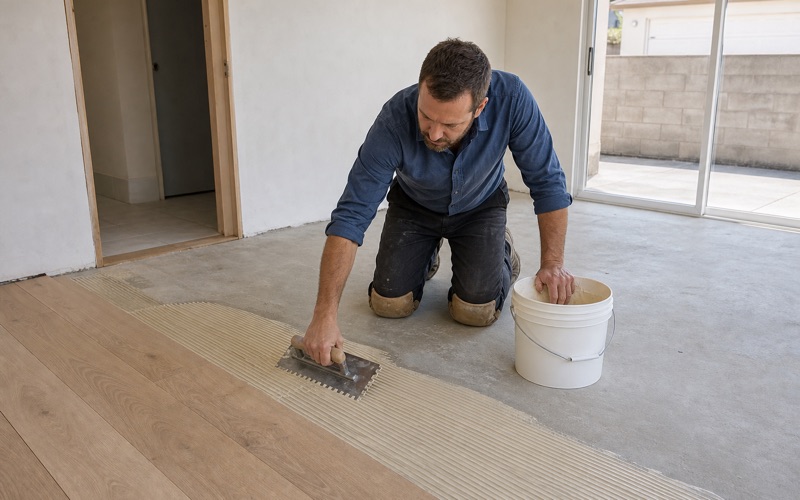
With most of the housing built after 1950, a large share of these houses sit on slab, and on a slab the wood floor options are glue-down or floating engineered. Solid nail-down needs something to fasten into that concrete does not provide. That is not a downgrade. A well-chosen engineered board with a substantial wear layer over a properly prepared slab will comfortably outlast a poorly specified solid floor, and it is the correct product rather than the fallback.
We test the slab before any material is ordered, with an in-situ relative humidity probe placed to the ASTM F2170 method. A slab that looks entirely dry can sit well above the level a wood floor tolerates, and the floor is what pays for that assumption.
Where Raised Floors Turn Up
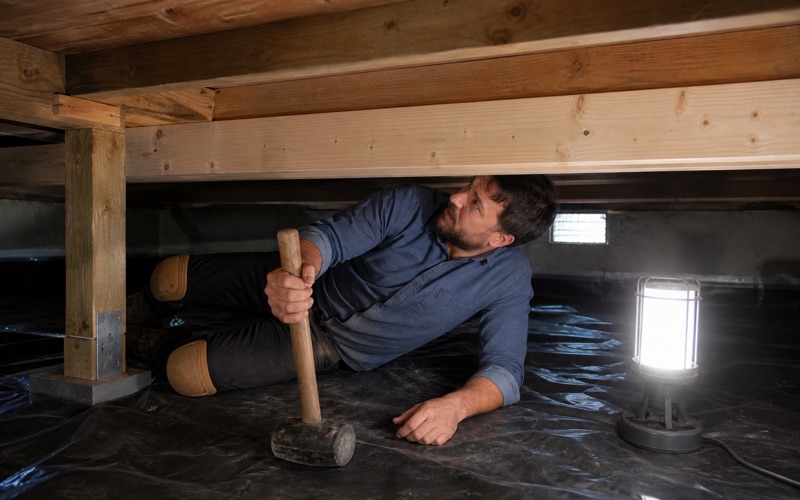
Not everything here is slab, and the older pockets of the city carry raised construction with a crawl space underneath. Those houses have the full range of options available to them, including solid nail-down. They also have the full range of moisture questions. Bare soil under a raised floor releases moisture continuously, and a ground cover with clear ventilation is a cheap intervention that prevents an expensive problem.
We establish which type a house is from below wherever there is access, rather than from the doorstep. Additions built on slab behind an original raised house are common, and the answer genuinely changes from room to room.
Flatness Before a Floating Floor
A floating floor over an uneven slab fails at the joints, because the boards are locked to one another and unsupported in the hollows. It is the single most common reason a click-lock floor develops creaks and separations. We measure across the room with a straightedge rather than spot checking, since the deviation that matters is usually a gentle fall across a long run. Grinding or self-leveling compound gets priced as its own item on the quote.
Burying that inside a rate per square foot is how a quote comes in attractively low and finishes somewhere else. It is a real cost and it belongs where the customer can see it.
Getting the Installation Right
Acclimation With Logged Readings
Material comes into the house and sits in the rooms it will live in until it reaches equilibrium, with moisture readings taken on arrival and again before the first board is fastened. Board laid at the wrong moisture content gaps or cups within its first year. That waiting period is the stage most often compressed when a job runs late, and it is the one that never should be. Nothing done afterward corrects a floor that was laid two days early against its own readings.
We put those readings on paper with dates. It is what supports a manufacturer warranty later and what tells anybody working on the house afterward what conditions the floor went into.
Expansion Allowance and Fixed Objects
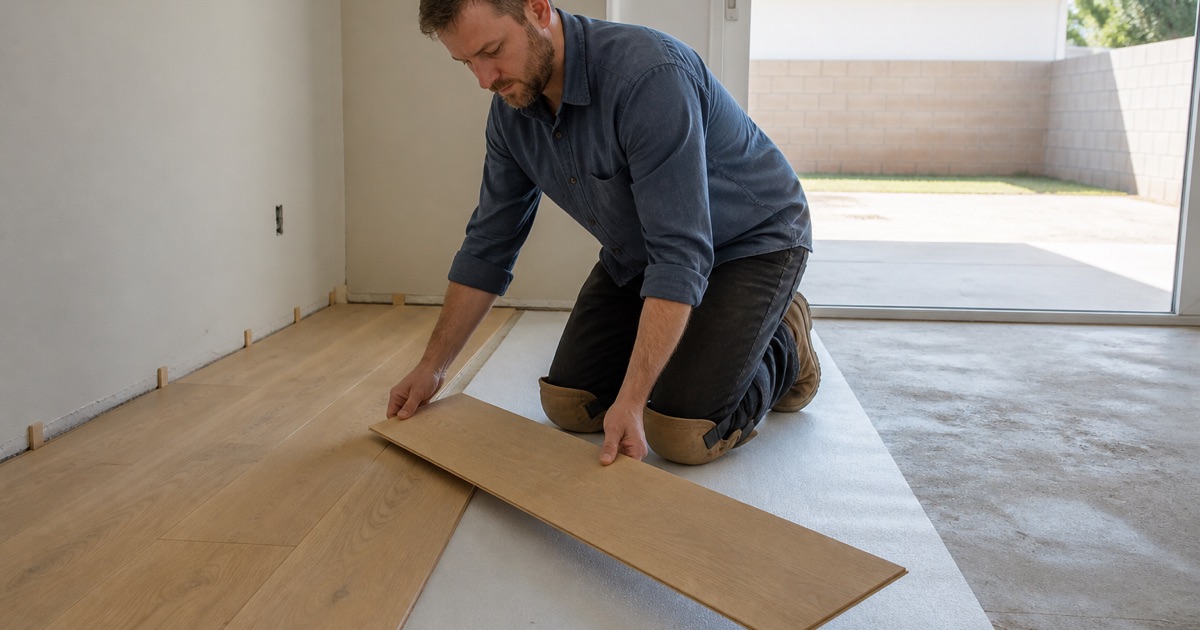
Every wood floor needs room to move at the perimeter, concealed under the baseboard or shoe molding, and the gap is calculated against the width of the run rather than set at a standard figure. Fitting cabinetry or a heavy fixed island hard onto a floating floor pins it in the middle of its own field, which is among the most reliable ways to buckle an otherwise sound installation. We plan around anything fixed before the floor goes down.
Filling that gap later, usually with caulk during a decorating job, produces the same result a year afterward. It is worth knowing it is there and worth leaving alone.
Transitions and Where a Floor Should Stop
A continuous floor through several rooms makes a house read considerably larger than one broken at every doorway, and there are still places a break genuinely belongs, particularly where wood meets tile at a bathroom or laundry. Those transitions have to allow the wood to move rather than clamping it down at its most vulnerable edge. We detail them deliberately and place them where they read as intentional rather than where they happened to be convenient. On a large open plan a threshold in the wrong opening is more visible than one placed thoughtfully, and it is an awkward thing to revisit once the trim has been fitted and decorated.
Living With the Floor Afterward
Cleaning Without Shortening Its Life
Wood floors are damaged far more often by cleaning than by traffic. Standing water, steam mops and abrasive products all take life off a finish, and steam in particular drives moisture straight into the joints. A dry pick-up followed by a barely damp pass with a cleaner made for the finish that is actually on the floor is the entire routine. We tell you which finish you have, because the products are not interchangeable and the wrong one dulls a surface permanently.
Felt pads under furniture and a mat at the entry do more for a floor than any product does. It is unglamorous advice and it is worth considerably more than most of what gets sold as floor care.
Sunlight, Rugs and Even Coloring
Wood changes color with light exposure, and most species darken or amber over the first couple of years. A rug left in one place through that period leaves a permanent lighter rectangle when it eventually moves. Moving rugs occasionally during the first year or two lets the floor even out. It is a small habit that avoids a problem which cannot be corrected afterward without sanding the entire floor back.
We mention it at handover rather than leaving it to be discovered. It is the kind of thing a contractor knows and a homeowner has no particular reason to.
Repairs Over a Long Ownership
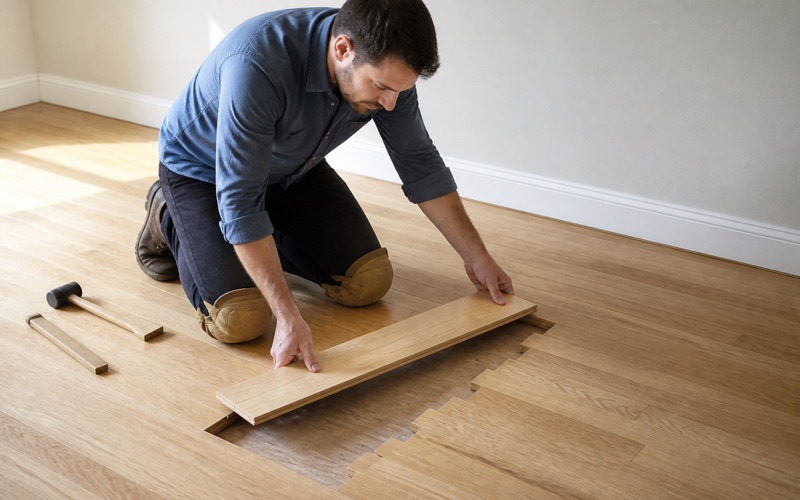
Across twenty years something will get dropped, dragged or spilled, and a floor that can be repaired locally is worth a great deal more than one that cannot. Individual boards can be lifted and woven in so the repair disappears. That is far easier when the original specification was recorded. We keep the product, grade, width and finish on file for the floors we lay, so a repair years later matches rather than approximately matches.
It also matters at the point of sale. A floor with a documented specification and a known refinish history is a straightforwardly better asset than one nobody has any record of.
- Licensed & Insured
- 20+ Years Experience
- Free Written Quotes