Bell Gardens Wood Flooring provides wood flooring in Lakewood for one of the most uniform housing stocks in Southern California. The city was built out in a concentrated push in the early 1950s, which means the same handful of plans repeat across whole streets and what is under one floor is a good guide to what is under the next. That uniformity is genuinely useful to a contractor, and the single most useful thing about it is this: houses of that era and that specification were routinely built with oak strip flooring throughout, and an enormous amount of it was carpeted over in the decades since and never seen again.
So the first thing we do in a Lakewood house is lift a corner of the carpet. More often than not there is a floor under there worth restoring, and restoring it is both cheaper than a new floor and better material than anything currently sold.
What Is Under the Carpet
Original Oak Strip
Houses of this period were commonly laid with narrow oak strip, and narrow strip is exactly why so much of it has survived in good condition. A narrow board moves less across its width than a wide one, so it gaps less, cups less and stays flatter across seventy years. Carpet is also a surprisingly good preservative. A floor that has been covered since the 1960s has been protected from sunlight, from traffic and from the cleaning products that shorten a finish, and it frequently comes up in better condition than an equivalent floor that stayed exposed.
Lakewood had a population of 82,496 at the 2020 census, bordered by Long Beach on three sides, with Bellflower to the north, Cerritos to the northeast, Cypress east and Hawaiian Gardens southeast. The consistency of its build-out is what makes this such a reliable expectation.
Lifting Carpet Without Damage
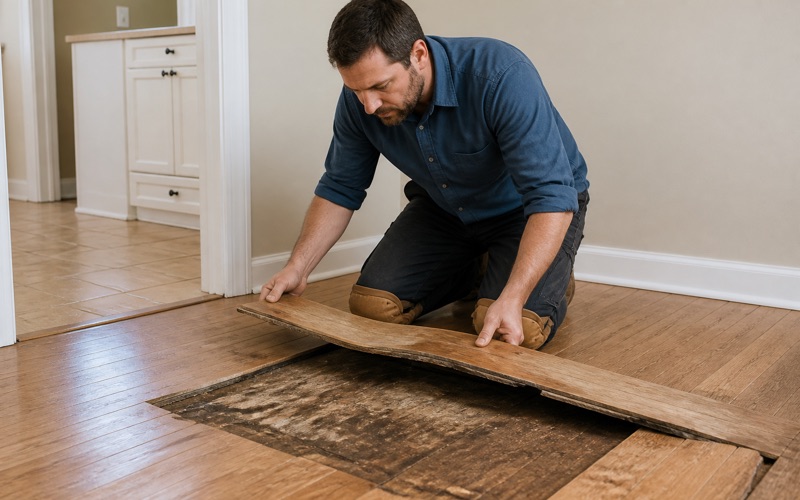
The two things that damage a floor during carpet removal are tack strip and staples. Tack strip runs around the entire perimeter and prising it up carelessly splinters the boards along every wall, in exactly the place a border or a baseboard reveal will show it. Pad staples through the field are the other issue, and there can be a great many of them. They pull out cleanly with the right tool and tear the surface with the wrong one, and on a floor that is going to be sanded anyway the difference still matters.
We lift carefully rather than quickly, because the perimeter damage caused by rushing is exactly the area a sander struggles to reach. It is a slower morning and it saves a considerably harder afternoon.
Judging What Is Left
The decisive question is how much thickness remains above the tongue, since that determines whether the floor can be sanded at all and how many times more it can be. We measure at a vent or a threshold rather than judging from the surface. A floor that has been under carpet since the sixties has usually been sanded once at most, which means most of its life is still ahead of it. That is a very different proposition from a floor that has been exposed and refinished three times.
Where the news is bad we say so directly. A floor already taken down to the tongue has nothing left, and no amount of skill puts thickness back into a board that has given up its last refinish. Looking for wood flooring closer to South El Monte? See South El Monte Wood Flooring.
Restoring Rather Than Replacing
Why It Is Usually Cheaper
A restoration involves no material purchase, no subfloor preparation and no disposal beyond sanding waste, which is why it frequently costs a fraction of a new floor. People are regularly surprised by the gap. It also keeps original material in the house, and mid-century oak strip is generally better stock than the equivalent grade sold today. The trees it came from grew differently and the milling standards were different.
We price both options so the choice is genuinely yours rather than presented as a foregone conclusion. Occasionally somebody wants a different look and that is entirely legitimate; the point is that they should be choosing rather than being told.
The Sanding Itself
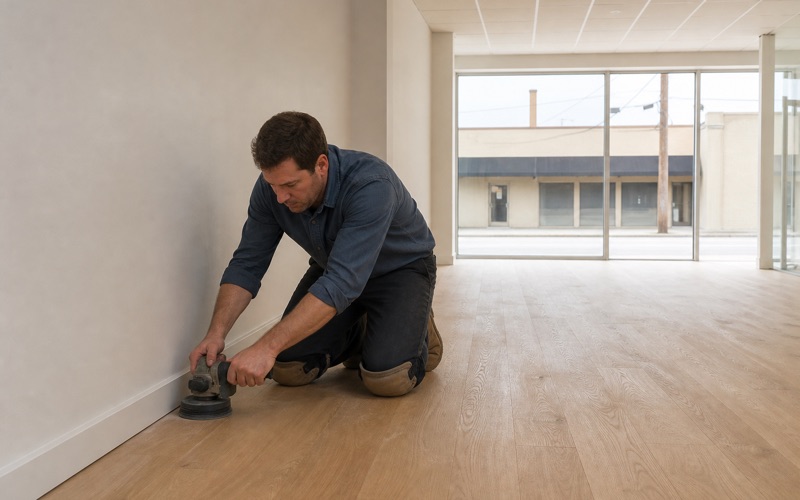
We work through a proper grit sequence so each pass removes the scratch pattern the previous one left, taking the minimum that clears the damage rather than the maximum the machine will do. Skipping grits is how thickness gets wasted. The buffing stage that blends the field with the perimeter is not optional. Without it there is a visible ring around the room where the edger worked, and on a large open plan that line is obvious from the doorway.
Corners are hand work, and around any built-in cabinetry or a fireplace they always will be. Those areas are exactly where somebody’s eye lands when they walk into a room.
Finish and Color
An original mid-century floor has taken on a color from decades of light and use that no new finish reproduces exactly, and on most of these houses the aim is to keep it rather than change it. A clear waterborne finish preserves what is there. Oil-modified will warm it further, which suits some interiors and overwhelms others. We sample both on the actual floor in the room’s own light rather than working from a chart or a sample board.
Sheen matters as much as color. Lower sheen conceals traffic and small imperfections considerably better than gloss, which picks out every ripple the light crosses on an older floor.
When Replacement Is the Answer
Damage That Cannot Be Sanded Out
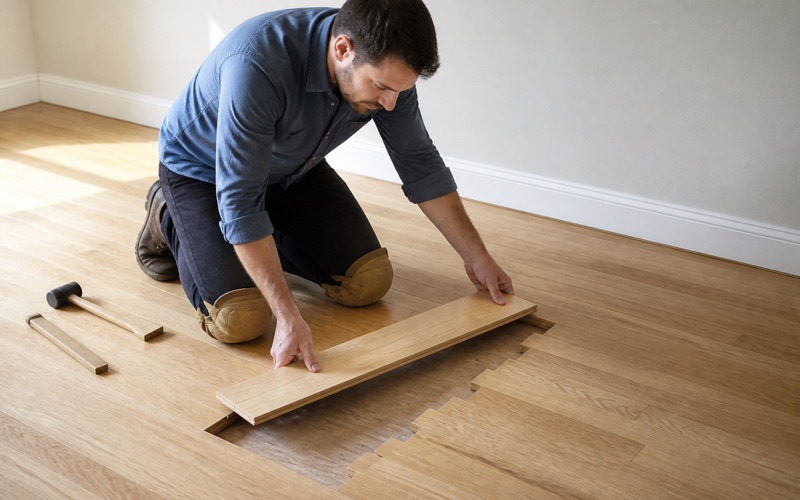
Pet stains that have gone through into the wood generally do not sand out, because the discoloration runs deep and the odor is in the fibers rather than on the surface. Board replacement woven into the field is the real fix. Water damage that reached the subfloor, boards split along the grain across a room, and areas that have been patched badly in the past are all replacement conditions rather than restoration ones.
We identify these before quoting so the price does not change on the second morning. Finding them with the floor open is the most common reason a restoration quote gets revised.
Matching Board of This Era
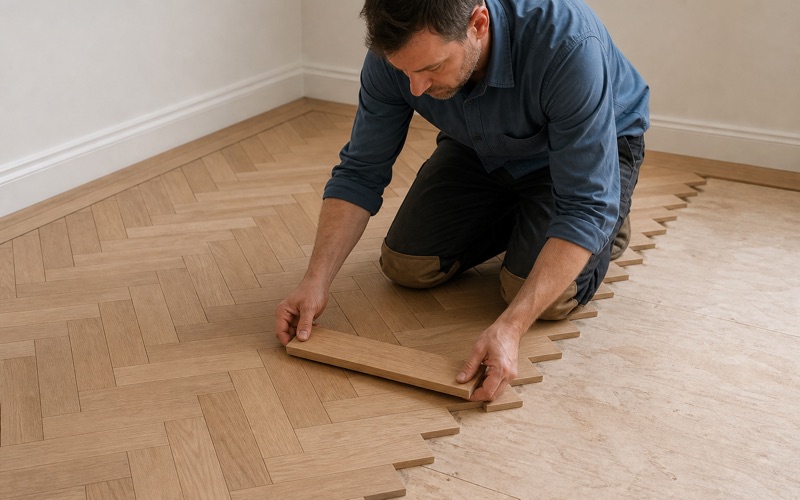
Where individual boards need replacing within a restored floor, matching means species, grade, width, thickness and tongue and groove profile. On mid-century oak strip the profile is usually the difficult part. Salvage is often the answer and it is worth the search, particularly here where the same specification repeats across so many houses. A board saved from one job is frequently exactly what the next street turns out to need.
We say at the quote whether a genuine match is achievable rather than discovering it once boards are already up. That is the point at which a modest repair turns into a conversation about a whole room.
New Floors Over This Substrate
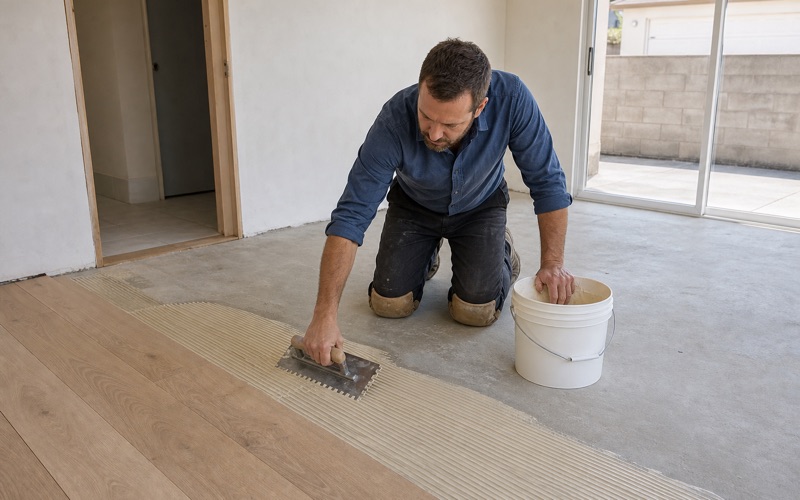
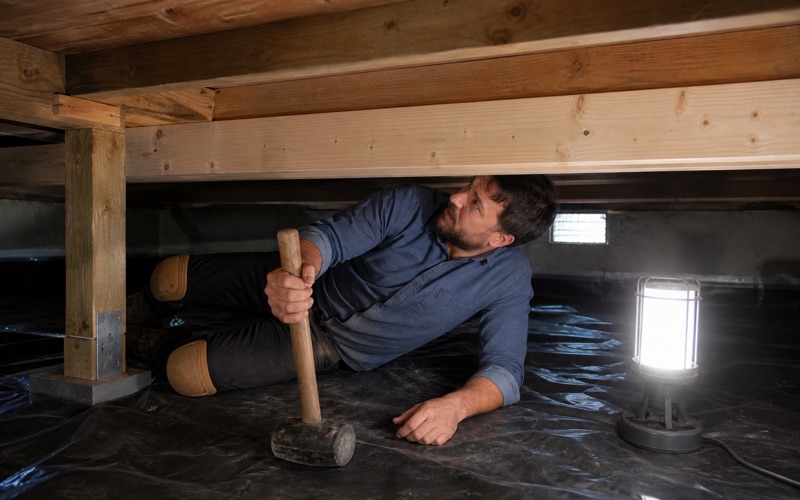
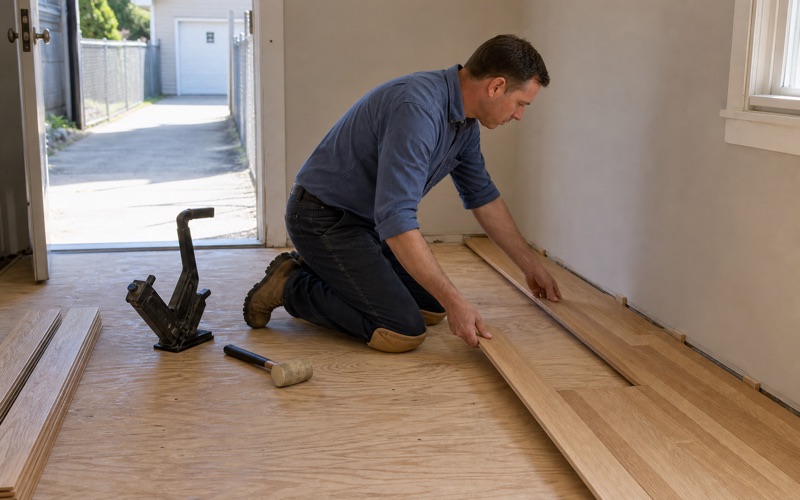
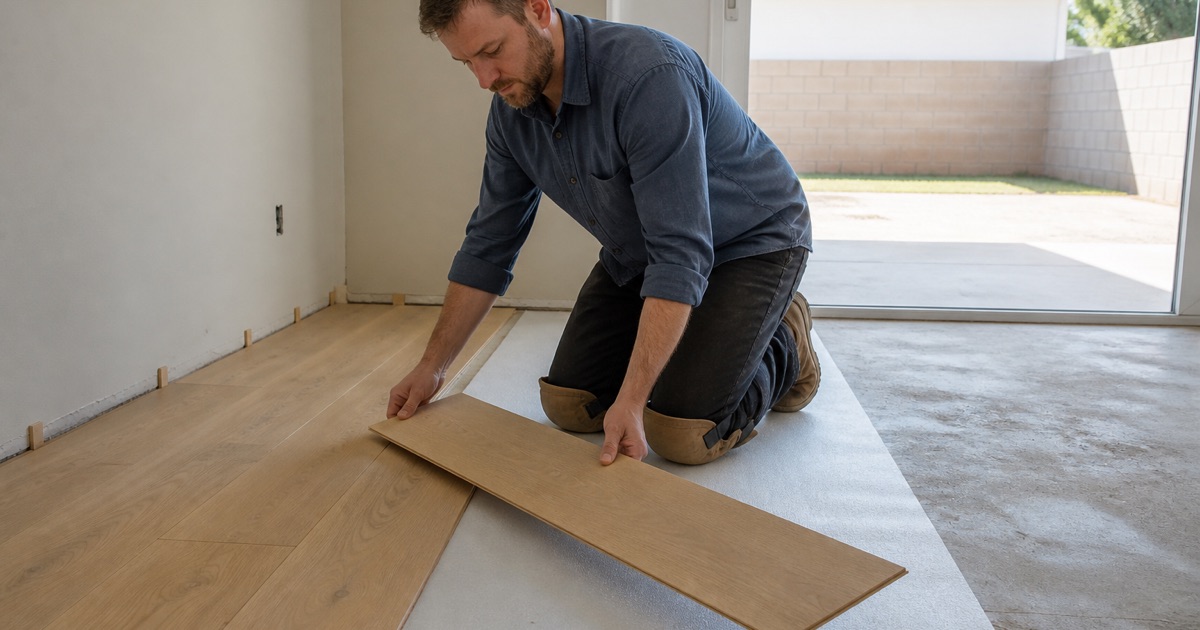
Where a floor genuinely has to be replaced, a sound wood subfloor is the best substrate available, and solid nail-down over it is the longest-lived option we install. It can be sanded several times across many decades. We check the subfloor for movement, fastener pops and moisture content before choosing, because a floor fastened to a moving deck moves with it regardless of how well it was laid. Where the budget does not stretch to solid, engineered over the same sound subfloor is a perfectly respectable answer and can be nailed rather than floated, which is the most secure installation available to it.
Practical Matters
Occupied Houses and Sequencing
Most of this work happens with the household staying put, so the sequence gets agreed before anything is ordered: which rooms first, where furniture goes, and which nights a coated floor closes a route between rooms. For a full sand everything comes out of the room including closet contents, and closets are the part people consistently underestimate. We flag them specifically at the quote rather than discovering them on the first morning.
Waterborne finishes cure faster and carry far less odor than oil-modified systems, which usually matters more in an occupied house than any difference in appearance. Those dates go in writing.
Lead-Safe Practice
Houses built in the early 1950s fall well within the pre-1978 range, so sanding here is covered by the federal Renovation, Repair and Painting rule. Containment, sealed openings and controlled cleanup are required rather than optional.
We work that way as standard, and it produces a better finish as a side effect. Most of what spoils a coat is airborne dust settling into it while still wet. The cleanup standard those rules set is higher than a broom and a shop vacuum, and it is the part most often skipped by contractors who do observe the containment itself.
The Same Plan, Repeated
Because the same house plans recur across the city, what we learn on one job frequently transfers directly to the next. Subfloor construction, joist spacing and the typical condition of an original floor are all reasonably predictable here.
We still survey each house individually. Thirty years of separate ownership, additions, re-roofing and plumbing alterations mean two houses from one plan are rarely identical by the time we see them. It also means neighbors compare notes, which is a reasonable discipline for a contractor to work under and one we have no objection to at all.
- Licensed & Insured
- 20+ Years Experience
- Free Written Quotes