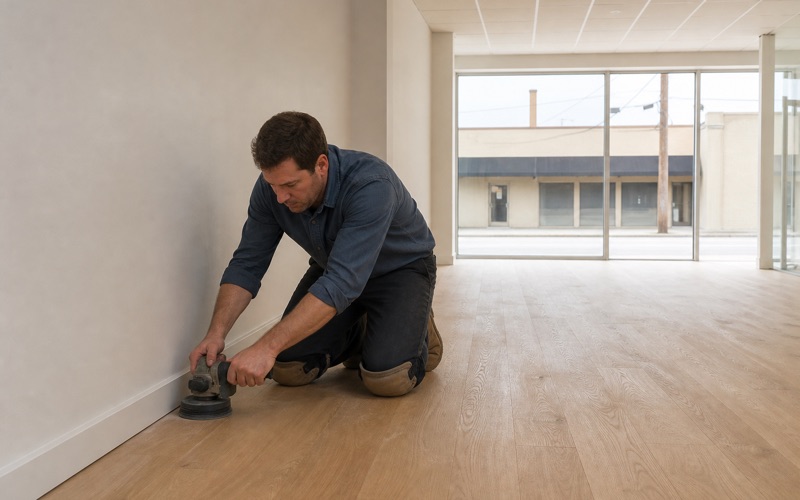
Bell Gardens Wood Flooring supplies and restores wood flooring in Huntington Park for a housing stock built largely in the first decades of the twentieth century, when this was a streetcar suburb rather than part of a continuous metropolis. Around two houses in five here predate 1950, and the character of that period is still the defining feature of the interiors. Those houses were built with wood floors as standard, not as an upgrade. Oak strip in the front rooms and Douglas fir elsewhere was ordinary construction, and a great deal of it is still in place under carpet, vinyl or laminate laid over it at some point in the intervening decades.
That changes what the job usually is. Far more often than in newer areas, the right recommendation here is to uncover and restore what is already down rather than to specify something new, and knowing how to tell the difference is most of the value we bring to a first visit.
What Is Under the Carpet
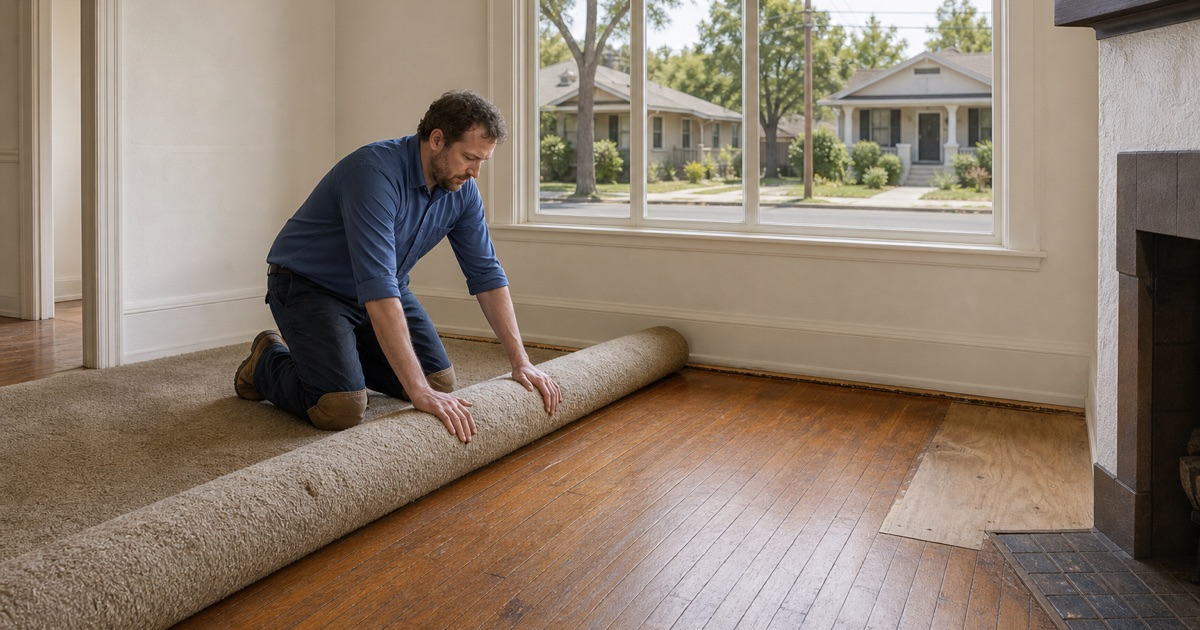
Recognizing Original Fir
Douglas fir was used extensively in houses of this period and it is frequently mistaken for a lesser material because it is softer than oak. Old-growth fir is tight-grained, dimensionally excellent and quite unlike anything sold under the same name today. It dents more readily than oak and that is genuinely part of its character rather than a defect to be engineered away. We identify it correctly before recommending anything, because a contractor who mistakes fir for a cheap softwood will suggest replacing a floor that ought to be kept.
The grain also takes finish very differently from oak, and a stain chosen from an oak sample will not land the same way on fir. We test on the actual boards rather than working from a chart, because this is one of the species where the difference is dramatic.
Oak Strip in the Front Rooms
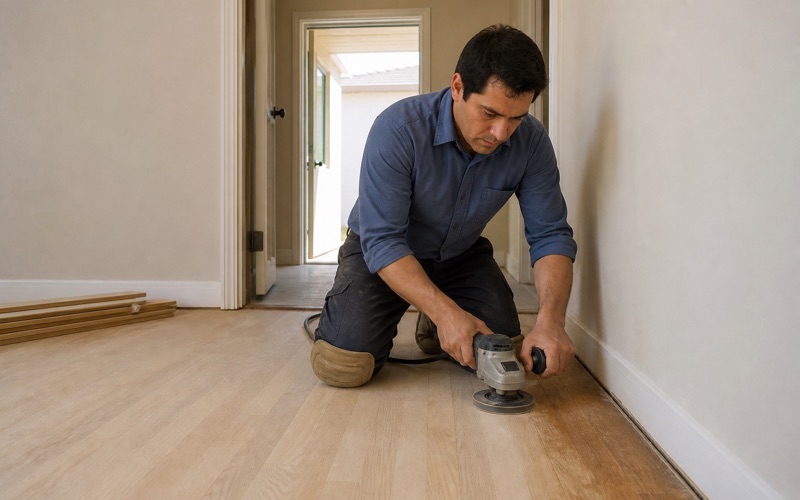
Narrow oak strip laid in the principal rooms is the other common find, often with a simple border or a change of direction at a threshold. Where it has been under carpet since the sixties it is frequently in better condition than an equivalent floor that stayed exposed. Tack strip damage around the perimeter and pad staples through the field are the usual problems, and both are routine to deal with during a sand. What matters is the thickness remaining, which we measure at a vent or a threshold rather than estimating.
Occasionally a floor turns out to have been sanded more times than the surface suggests, and there is very little left above the tongue. We would rather establish that in the first hour than halfway through a sanding pass, when the options have narrowed considerably.
Deciding Between Restoring and Replacing
The honest comparison is not simply cost. A restored original floor keeps material in the house that cannot be bought now, and on these houses it almost always looks more at home than a new floor does. Where the boards have been sanded to the tongue already, where damage is widespread, or where the subfloor beneath has failed, replacement is the right answer and we will say so. The point is that the question gets asked properly rather than answered by whichever job is larger.
There is also a middle route that gets overlooked. A floor too far gone to sand can sometimes take a screen and recoat that buys another decade, and that is a legitimate answer for a household that is not ready to replace a floor this year. Looking for wood flooring closer to Walnut Park? See Wood Flooring Services in Walnut Park.
Sanding a Softer Floor
Grit Sequence and Not Going Too Far
Fir sands quickly, which sounds convenient and is actually the hazard. It is straightforward to take off far more material than necessary, and on a floor that has already been refinished twice that thickness is not recoverable. We work through a proper grit sequence and take the minimum that removes the damage rather than the maximum the machine will do in a pass. On a softer species that discipline matters considerably more than it does on oak.
Skipping a grit is the other way thickness gets wasted. Jumping from a coarse paper straight to a fine one leaves scratches the finer grit cannot remove, and the usual response is another coarse pass, which costs more material than doing the sequence properly would have.
Machine Marks Show More
Softer wood records every mistake a machine makes. Chatter from a drum sander, a dished edge where the edger dwelled, and the ring where the two meet are all more visible on fir than on a harder species. The correction is a proper buffing stage to blend the field and the perimeter, and hand work in the corners. It is slower and it is the difference between a floor that looks restored and one that looks sanded.
Around a fireplace, in bay windows and under radiators the machines simply cannot reach, and those areas are done by hand or not properly at all. They are also exactly where somebody’s eye goes when they walk into a room of this period.
Finish Choice on Older Boards
An original floor of this age has usually taken on a color that no new finish can fully reproduce, and the aim is generally to keep it rather than to alter it. A clear waterborne finish preserves what is there; an oil-modified system will warm it further. We sample both on the actual floor before committing, in the room’s own light. A finish decision made from a sample board in a different building is the most common way somebody ends up with a floor a shade they did not intend.
Sheen is the other half of that decision and it gets less attention than it deserves. On an old floor with some unevenness left in it, a lower sheen is far more forgiving than a gloss finish, which picks out every ripple the light crosses.
The Character of the Area
A Streetcar Suburb’s Interiors
Huntington Park includes the separate communities of Florence, Firestone Park, Graham and Walnut Park, and the city’s population is 97% Hispanic or Latino with about half born outside the United States. The housing reflects a long, continuous residential history rather than a single build-out. For flooring, that means the interiors have layers: original boards, mid-century alterations, later coverings. Reading those layers correctly is what tells you which parts of a house are worth restoring and which have already been changed beyond it.
Storefronts and the Rooms Above Them
The commercial corridors here carry the other half of the work, with retail at street level and residential space above. A wood floor in a commercial ground floor is a different specification from the same floor in a house, with a harder finish system and a recoat interval set by traffic. Where a floor sits above another occupied space, impact sound becomes a genuine question rather than a courtesy, and it is governed by requirements written for shared assemblies. We specify underlayment against that rather than by habit.
It is worth saying that a detached house has no such obligation at all, because the requirement attaches to the assembly between separate dwellings. Applying an apartment specification to a single-family house is a cost with no benefit attached to it.
Working in Occupied Buildings
Most of this work happens with people living or trading in the building. Containment at the machine, sealed openings and a route cleared daily are what make that workable, and they matter more where the space above or beside is occupied by somebody who did not order a floor. We agree the sequence in advance, including which nights a coated floor is not walkable. In a building with a single stair that is a genuine constraint rather than a detail.
Where a shop is trading underneath, the noise question runs the other way as well. Sanding above an open retail floor is disruptive to the business below, so that stage generally belongs outside trading hours by agreement rather than by assumption.
Practical Details
Lead-Safe Practice
With housing of this age, nearly all sanding work here falls under the federal Renovation, Repair and Painting rule. Containment and controlled cleanup are the required method rather than an optional upgrade, and we work that way as standard. It is worth understanding that the requirement exists because of exactly this kind of building. Sanding is the disturbance the rule was written about, and older paint layers around a floor’s perimeter are precisely what it is concerned with.
Matching Period Board
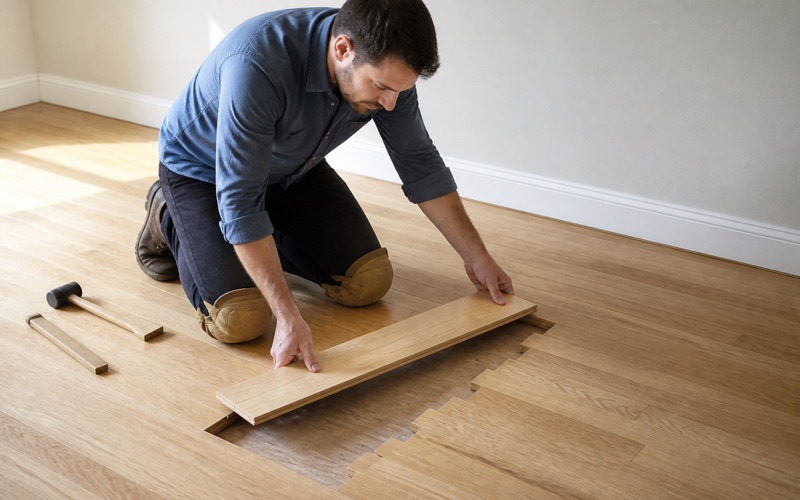
Where replacement boards are needed, matching the profile of a floor laid ninety years ago is usually the difficult part rather than finding the species. Milling standards have changed and thickness varied considerably. We identify everything before sourcing and tell you at the quote whether a genuine match is achievable. Salvage is often the answer on a floor of this period, and it is worth the search on a floor worth keeping.
We keep an eye out for reclaimed stock of the right era and species as a matter of routine, because these floors recur across this whole area. A board saved from one job is frequently exactly what the next house on the same street turns out to need.
Keeping Original Material in the House
Our general bias on these houses is toward keeping what is there. It is usually cheaper, it is almost always more appropriate to the building, and the material itself is frequently better than what would replace it. We will tell you when that is not the right call. A floor with nothing left to sand is a floor at the end of its life, and pretending otherwise serves nobody.
- Licensed & Insured
- 20+ Years Experience
- Free Written Quotes