
Bell Gardens Wood Flooring handles hardwood floor repair throughout Bell Gardens, CA and nearby cities including Maywood, Commerce, Bell, Walnut Park and East Los Angeles. Repair is the part of this trade where the temptation to oversell is strongest, and where the difference between an honest contractor and a careless one shows up fastest.
Most of the damaged floors we are called to do not need replacing. A split board, a stained patch, a soft spot over a failed joist or a run of squeaks are all local problems with local fixes. The skill is in making the repair disappear into the surrounding floor rather than reading as a rectangle of newer wood.
That means matching species, grade, width, thickness and board profile, and then weaving the new boards into the existing field so the joints stagger the way the original does. On floors from the 1940s and 1950s the profile is usually the hard part, because milling standards have moved since. We tell you before we start whether we can genuinely match yours.
Repairs We Do Most
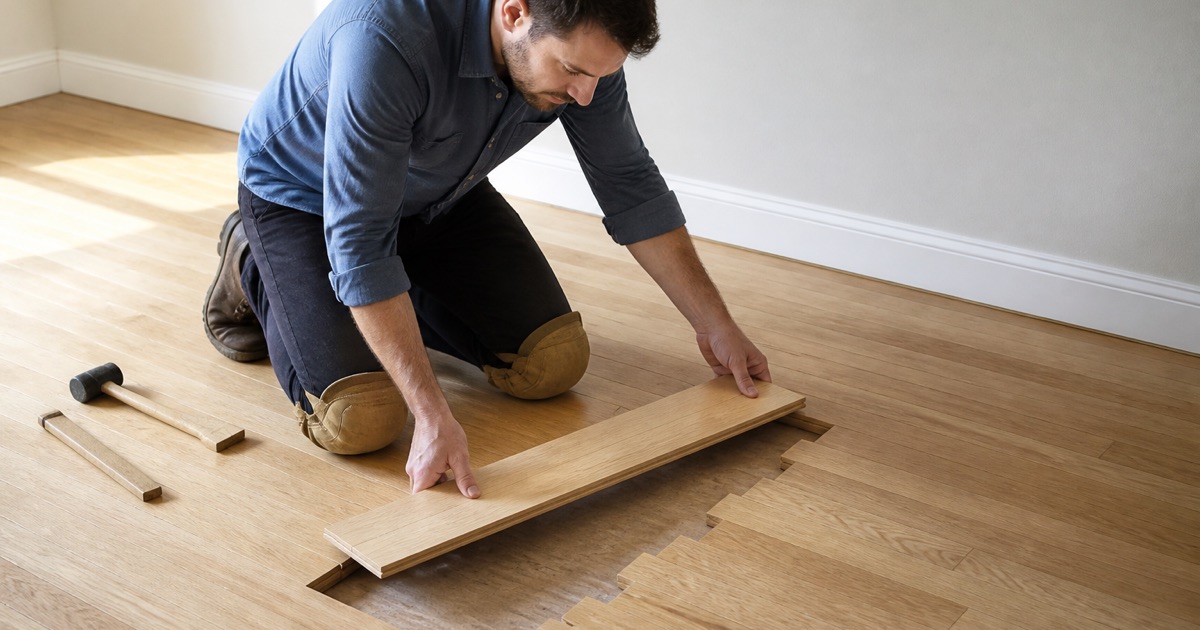
Single and Multiple Board Replacement
A cracked, split, burned or deeply stained board comes out on its own without disturbing its neighbors, and a matching board goes in. Done properly the repair is invisible once the floor is finished. Done as a straight-line patch it announces itself for the rest of the floor’s life, which is why we weave rather than cut a block out.
Weaving and Lacing Into Existing Floor
Where a larger area has to be replaced, or where a doorway or a removed wall has left a gap in the field, the new boards are laced into the old with staggered end joints so there is no visible seam line. It is slower than laying a patch and it is the only version that disappears under a finish.
Dutchman Patches
For localized damage that does not justify lifting whole boards, a dutchman is a shaped piece let into the existing board, matched for grain direction and species. It is a traditional repair and a good one where the alternative would mean disturbing a large area of sound floor to reach one flaw.
Squeaks, Movement and Soft Spots
Finding Where a Squeak Comes From
A squeak is almost never the finish boards rubbing each other. It is usually the subfloor moving against a joist, or a fastener that has worked loose and is now moving in its hole. Diagnosing it from above and fixing it with surface screws hides it for a season. We locate it properly before deciding how to approach it.
Fixing From Underneath
Where there is crawl space access, the correct repair is from below with blocking, shims and screws into the subfloor, which leaves nothing visible on the finished side at all. Bell Gardens has a great deal of raised construction, so this route is available far more often here than people expect.
Soft Spots and Failed Subfloor
A floor that flexes underfoot has a problem below it rather than in it, usually rot, a sagging joist or delaminated sheet subfloor. Refinishing over it changes nothing. We open it up, establish what is actually happening, and price the structural repair separately, because that work is a different job with a different permit position.
Gaps, Cupping and Seasonal Movement
Gaps That Open and Close
Solid wood moves across its width with the seasons, so hairline gaps that appear in the drier months and close again are normal and need nothing done to them. Gaps that keep widening year on year, or that never close, indicate a moisture problem or boards laid at the wrong moisture content. Measuring tells us which.
Filling Gaps, and When Not To
Filler in a gap that still moves is pushed out within a year and often takes finish with it. On a floor that is genuinely stable, gaps can be filled during a refinish and stay put. On one that is still moving, the honest answer is to leave them or to replace the affected boards.
Matching an Older Floor
Species, Grade and Width
Matching starts with identifying what is there, which is not always what people assume. Plenty of floors here are Douglas fir rather than oak, and fir behaves and finishes differently. We identify the species, the mill grade and the exact board width before sourcing anything, because a near-match is more obvious than a deliberate contrast.
Thickness and Profile
An older board’s tongue and groove profile may no longer be milled, and thickness varied more than it does now. Where the profile has been discontinued we can sometimes mill to match or adapt the new board to seat correctly. Where we cannot, we say so at the quote rather than discovering it with the floor open.
Sourcing Board for a Discontinued Floor
Where current milling will not match, salvage is often the answer, and reclaimed board of the right era and species can be worked to fit. It takes longer to find and costs more per board than new stock. On a floor worth keeping it is usually still cheaper than replacing the room.
Blending the Finish
New wood does not take stain the way wood that has been in a house for seventy years does, and matching a finish is a separate skill from matching a board. On a small repair we blend into the existing finish. Where the difference would show, the honest answer is refinishing the whole room, and we will say which situation you are in.
What We Will Tell You Not to Do
Refinishing Over an Unresolved Problem
Sanding a floor that is cupped from an active moisture source produces a crowned floor a few months later, and turns a repair into a replacement. We find and correct the source first, then let the floor equalize, then decide what it needs. That sequence takes longer and it is the only one that works.
Screwing Down a Squeak From Above
Face-screwing a squeaky floor from the finished side leaves plugs or filled holes across the boards and rarely holds, because the movement causing the noise is still there. Where crawl access exists there is a proper fix underneath. We use the visible route only when there is genuinely no access below.
Replacing a Room That Needs Three Boards
A floor with a few damaged boards and a tired finish needs board replacement and a recoat, not a new floor. It is a fraction of the cost and keeps original wood in the house. We would rather do the smaller job well than sell the larger one, and on older stock the original boards are frequently better material than the replacement would be.
- Licensed & Insured
- 20+ Years Experience
- Free Written Quotes