
Bell Gardens Wood Flooring installs engineered hardwood flooring across Bell Gardens, CA and the cities around it, including South Gate, Huntington Park, Pico Rivera, Montebello and Downey. Engineered board is what makes a real wood floor possible on a concrete slab, and a large share of the houses built here after about 1950 sit on one.
Engineered is not a compromise product, though it is often sold as one. It is a genuine wood wear layer bonded over a dimensionally stable core, and that construction is why it tolerates the moisture movement a slab produces and solid wood does not. A good engineered floor outlasts a badly chosen solid one comfortably.
What separates a good one from a bad one is almost entirely the wear layer, and that is the number most retail sales conversations skip. We put it in the quote in millimeters, because it decides whether your floor can ever be sanded and therefore whether it has a second life in fifteen years.
Choosing the Board
Wear Layer Thickness
The wear layer is the only part that can ever be sanded. A thin veneer of half a millimeter cannot be refinished at all and is a single-life floor. Two millimeters allows a light sand; three or more behaves much like solid wood and can be taken back properly more than once. We state the figure rather than describing the board as thick.
Core Construction
A plywood core with multiple cross-laid plies is the most stable option and takes fasteners well where the substrate allows. High density fiberboard cores are flatter and cheaper but less tolerant of moisture and generally cannot be nailed. The core decides which installation methods are available to you, so it gets settled before the surface appearance does.
Species, Grade and Formaldehyde Standards
The wear layer is real wood, so species and mill grade matter exactly as they do on solid board: white oak sits around 1360 on the Janka scale, hickory around 1820. Engineered product sold in California must meet the CARB Phase 2 and TSCA Title VI formaldehyde emission standards, and we specify compliant product as a matter of course.
Getting the Substrate Right
Testing the Slab First
No engineered floor goes down over a slab we have not measured. We place an in-situ relative humidity probe to the ASTM F2170 method, or run a calcium chloride test where that suits the job better, and hold the result against the 75 percent ceiling. A slab that looks dry can sit well above it, and the floor is what pays for the assumption.
Flatness and What It Costs
Floating floors are unforgiving of a slab that is not flat: a hollow under a click-lock floor becomes a creak and eventually a failed joint. We measure across the room with a straightedge and price grinding or self-leveling compound as its own line, so the substrate work is visible rather than buried in a per-square-foot rate.
Over a Wood Subfloor
Engineered goes down over plywood or board subfloor as readily as over concrete, and there it can usually be nailed or stapled, which is the most secure method available. We check the subfloor for movement, fastener pops and moisture content before choosing, because a floor fixed to a moving deck moves with it.
Installation Methods
Glue-Down
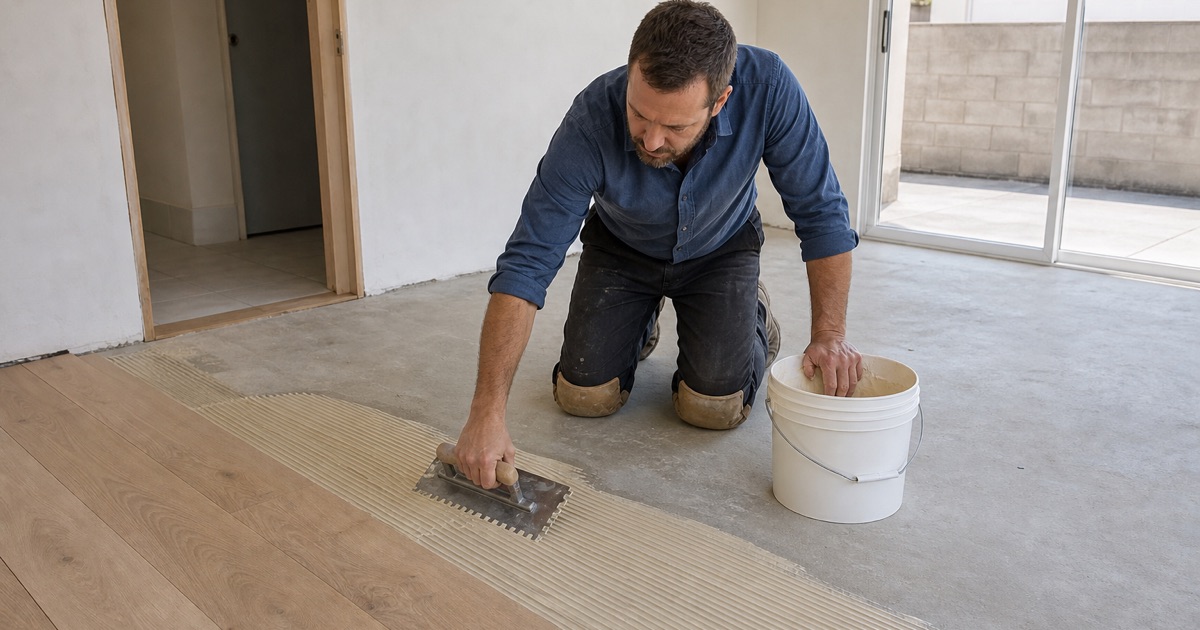
Full adhesive contact makes an engineered floor feel solid and quiet underfoot, close to the sensation of nailed solid wood. It demands a flatter, cleaner substrate and the correct adhesive for the slab’s moisture reading. It is also the harder method to reverse later, which is worth knowing before choosing it.
Floating
A floating floor is not fixed to the substrate at all; the boards lock to each other and move as one field. It tolerates a slab with a history better than glue-down does, goes down faster, and lifts more easily. It needs a proper perimeter expansion gap, and it will sound hollower than a bonded floor.
Nail or Staple Down
Where there is a wood subfloor, cleats or staples at the correct crown width and spacing schedule give the most secure result available. We follow the fastener spacing the board’s own thickness and width call for rather than a habit, because under-fastening a wide board is how a floor develops squeaks in its second year.
Where It Suits This City
Slab Houses Built After 1950
A large share of Bell Gardens and the cities south of it went up on slab from the 1950s onward, and on those streets engineered is not the second choice, it is the only wood floor available. We would rather fit a well-specified engineered board there than talk somebody into a system that fights the house.
Rental Units and Turnovers
Where a floor has to survive tenants and be back in service on a date, a prefinished engineered board with a factory-cured finish goes down fast and needs no cure time before use. For owners running several units on one lot we quote per unit and sequence the work so units come back one at a time.
Upstairs Rooms in Multifamily Buildings
Where a floor sits over another dwelling, impact sound becomes a code question rather than a courtesy. Shared floor and ceiling assemblies between units are covered by California Building Code Section 1206, and the underlayment under a floating floor is doing acoustic work as well as leveling. We specify it against the requirement rather than by habit.
Living With an Engineered Floor
Expansion Gaps and Why They Stay
Every wood floor needs room to move at the perimeter, and on a floating floor that gap is what stops the field from buckling. It sits under the baseboard or the shoe molding where you never see it. Filling it, or fitting cabinets tight to a floating floor, is one of the most common causes of a buckled installation.
Cleaning Without Wrecking the Finish
Wood floors are damaged far more often by cleaning than by traffic. Standing water, steam mops and anything abrasive all shorten a finish’s life. A dry pick-up followed by a barely damp pass with a cleaner made for the finish you actually have is the whole routine, and we tell you which finish is on your floor.
Maintenance and Recoating
Engineered floors are cleaned and maintained exactly like solid ones, and a floor with a sound finish and adequate wear layer can be screened and recoated to reset its surface without touching the wood. That option is what makes a thicker wear layer worth paying for, and it is the routine that keeps a floor out of the replacement conversation.
- Licensed & Insured
- 20+ Years Experience
- Free Written Quotes