Bell Gardens Wood Flooring provides wood flooring in Cudahy for houses that are very rarely the only house on their lot. More than twenty years working these particular streets has taught us that the material and the finish are the straightforward part of a quote here, and that the genuinely variable cost is getting a floor, a crew and a set of machines into a dwelling that may sit two hundred feet back from the curb.
Almost nothing about a standard flooring visit survives that arrangement unchanged. A truck cannot get close to the rear house. Pallets have to be broken down and carried up a side driveway barely wider than a hand truck. Extraction hoses have to run past occupied front units, and the acclimation period means material has to sit inside a house that somebody is already living in.
None of this is a complaint about the city, and none of it makes the work harder to do well. It simply has to be priced into the quote rather than discovered on the second morning, which is the difference between a number that holds and a number that gets revised once the crew has seen the property.
Why a Cudahy Lot Has More Than One House On It
The Long Narrow Parcel
Residential parcels here are unusually deep and unusually narrow, a pattern carried straight down from the way the land was originally cut up and sold. A single lot can run several hundred feet back from the street while being barely wide enough to fit a house alongside a driveway, which produces a very particular kind of density. That geometry is a large part of why Cudahy has one of the highest population densities of any incorporated city in the United States without being a city of apartment towers. The density here is horizontal rather than vertical, it sits behind the front elevation, and you cannot see any of it from the sidewalk.
Several Detached Houses, One Address
What the parcel shape produces is a row of separate single-family houses running back down the lot, each a genuine detached dwelling with its own entrance, its own kitchen and its own floors. They are houses rather than units in a building, and they behave like houses in every way that matters to this trade.
For flooring that distinction carries more weight than it first appears to. The houses on one parcel were frequently built years or decades apart, they often sit on different foundation types, and they are almost never in comparable condition. Each one gets measured and assessed on its own rather than by extension from the one in front of it.
What That Means for a Quote
We price each house separately rather than averaging a rate across the parcel. An owner with three or four dwellings on one lot needs to know what each one costs, particularly in the very common case where only one or two of them are being done in a given year and the rest wait. Averaging is how a property owner ends up unable to attribute a cost to a specific unit, and how a contractor ends up quietly losing money on the rear house and recovering it on the front. Neither arrangement survives contact with a second job on the same parcel, so we do not use it in the first place.
Looking for wood flooring closer to Bell? See Wood Flooring Services in Bell.
What We Find in These Houses
Two Foundations on One Parcel
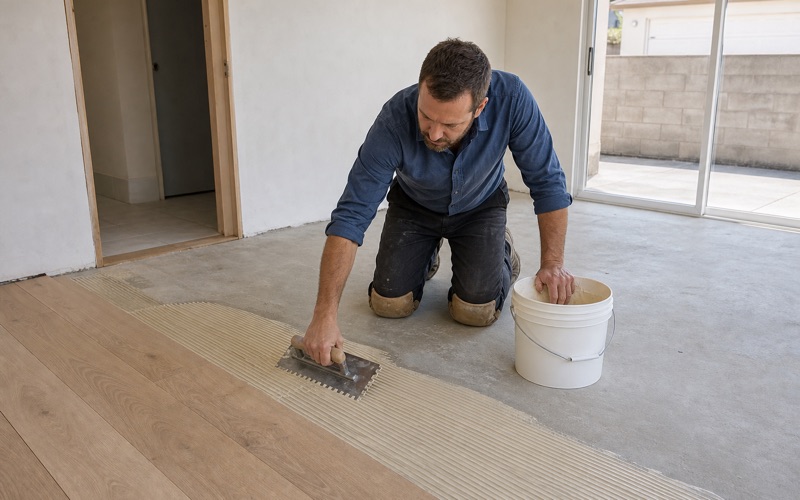
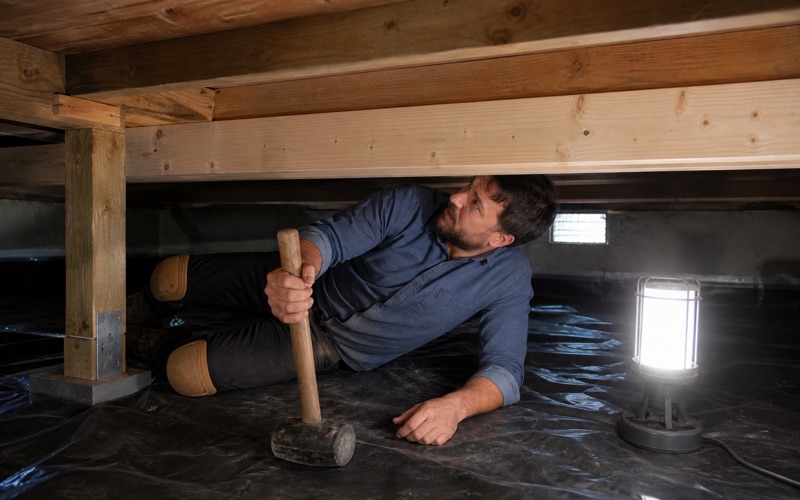
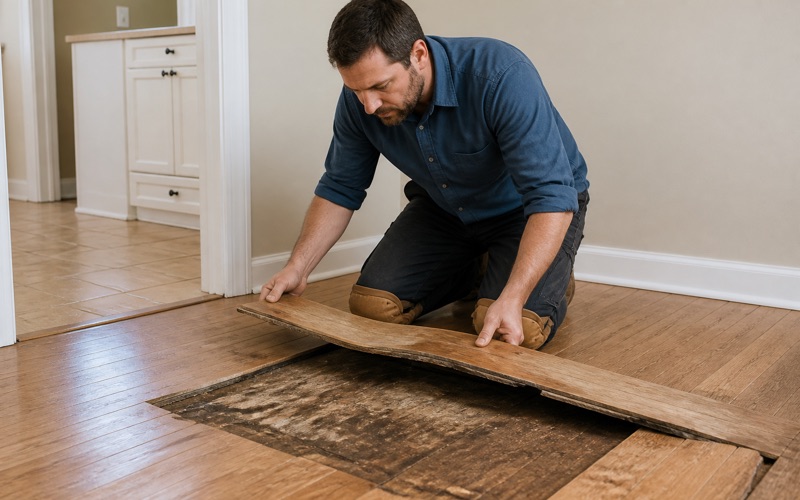
Because the dwellings on a lot went up at different times, it is entirely normal to find the front house on a raised floor over a crawl space and the rear house on a slab poured decades later. The two need different products, different preparation and different testing. We establish it per dwelling rather than per address. An owner told that their property is a slab property, on the strength of one unit, ends up with the wrong floor specified for the others, and that is a mistake that only becomes visible once the boards start cupping.
Small Rooms and Board Direction
These houses are compact, and in a small room the direction the boards run does more work visually than the species does. Running the length of the longest sightline makes a narrow room read as longer; running across it does the opposite and emphasizes every wall. We set that out with you in the room rather than deciding it on the truck. It costs nothing to get right at the start and it cannot be changed afterward without lifting the entire floor, which puts it firmly in the category of decisions worth five minutes.
Original Floors Worth Keeping
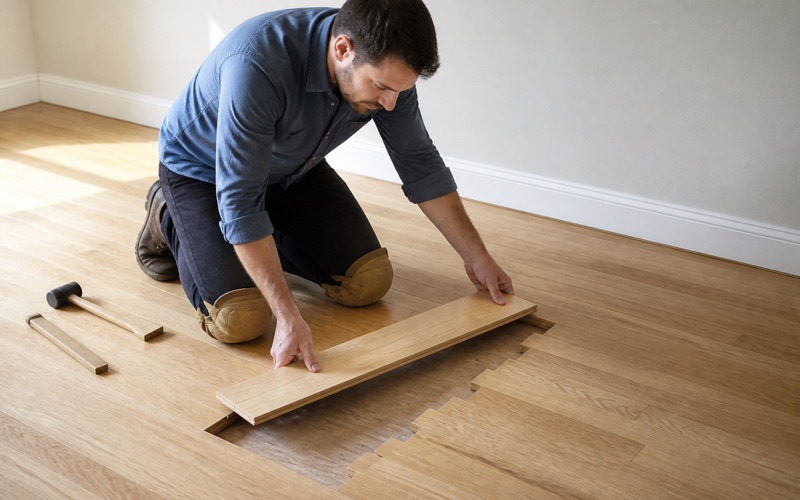
A good number of the older dwellings on these parcels still carry their original boards under later carpet or vinyl. Where those boards are sound, refinishing them is cheaper than replacement, keeps original material in the house, and very often produces a better floor than new stock would. We check before quoting a replacement. It occasionally costs us the larger job, and it is the right recommendation often enough here that making it a habit has been straightforwardly good for the business.
Access, Staging and Where Material Waits
Carrying Distance Is a Real Cost
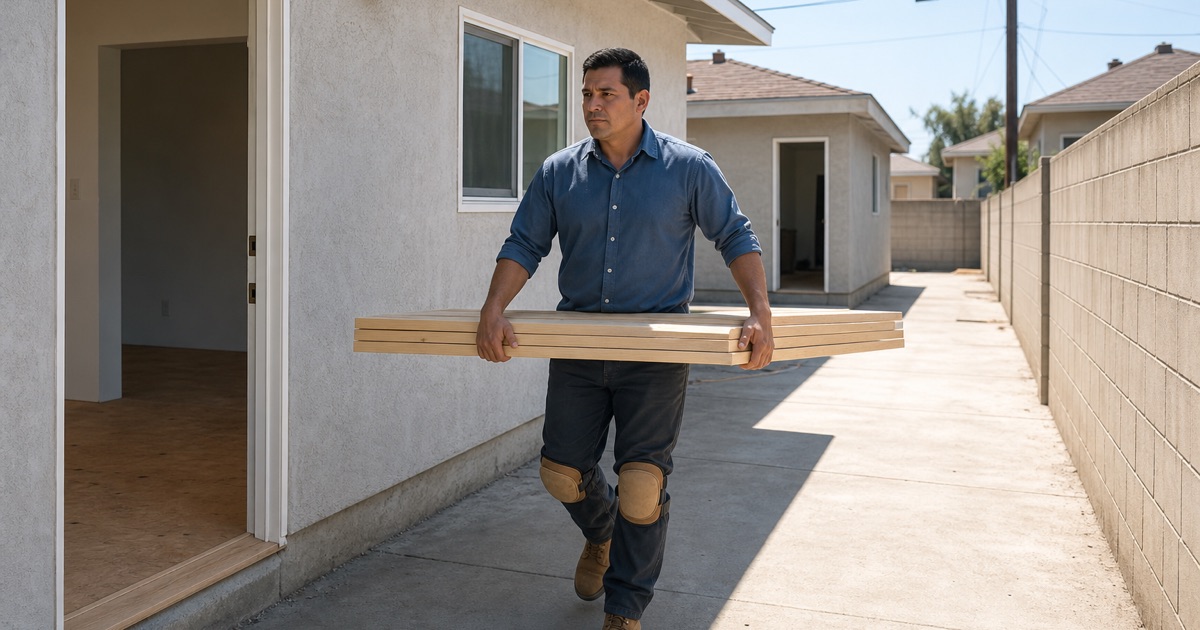
Wood flooring is heavy, it arrives on pallets, and somebody has to move it. Where the target house sits a hundred and fifty feet from the curb behind two other dwellings, with a side driveway too narrow for anything but a hand truck, the labor of moving material stops being a rounding error and becomes a line worth naming. We walk the route before quoting rather than after. The difference between the front house and the rear house on the same parcel can be substantial, and it is far better to know it while a number is still being written than to find it out on the morning the delivery arrives.
Acclimating Material Inside an Occupied House
Wood has to acclimate in the room it will eventually live in, with moisture readings logged when it arrives and again before the first board is fastened down. That means pallets of material sitting inside the house for several days, which is a genuine imposition in a small dwelling that somebody is currently occupying. We agree in advance where that material is going to sit and for how long, with whoever actually lives there rather than only with the owner. Turning up with a pallet and improvising around a family’s furniture is how a job starts badly and stays that way.
Machines, Power and Older Service
Drum sanders, edgers and extraction units draw serious current, and rear dwellings on these parcels sometimes run off electrical service that was never expected to carry it. A breaker that will not hold halfway through a sanding pass costs a day and risks damaging the floor at the point where the machine stopped. We check what is actually available before the work is scheduled rather than on the morning. Where the service will not support the machines, there are ways around it, and all of them need to be arranged in advance rather than improvised with a floor half sanded.
Working on a Property Where People Live
Keeping the Other Houses Out of It
The people in the other dwellings on the parcel did not order a floor and should not have to live through one. Containment at the working house, extraction at the machine itself, and a route in and out that gets cleared at the end of each day are what keep one unit’s job from becoming the whole property’s problem for a week. Where an entire dwelling is being done we seal the house rather than the individual room, which is both more effective and considerably less disruptive to the neighbors than sealing and unsealing rooms one at a time. It also means the access route stays clean, which matters more here than on an ordinary lot.
Sanding Inside City Hours
Sanding is loud, and with houses this close together there is no version of it that nobody hears. Construction work in this area is restricted in the evenings, and with dwellings sharing a parcel boundary a few feet apart we schedule the loud stages to finish comfortably inside those hours rather than pressing up against them. That occasionally means a job runs an extra half day, and it is worth it. A flooring crew that generates a noise complaint against the property has created a problem for the owner that outlasts the floor by a considerable margin.
Turnovers and Dates That Actually Matter
A large share of the work here happens between tenancies, where a unit has to be back in service on a fixed date and every day it is not is a day of lost rent. We work to that date and we say in advance what is genuinely achievable rather than agreeing to a schedule we already doubt. Sometimes the honest answer is that a screen and recoat will meet the date and a full sand and refinish will not. We would rather say that at the quote and do the smaller job well than commit to the larger one and hand back a floor that cannot be walked on when the tenant arrives.
- Licensed & Insured
- 20+ Years Experience
- Free Written Quotes